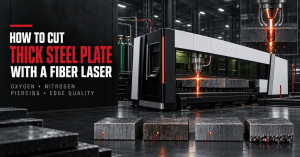
Cutting thick steel plate with a fiber laser is not simply a bigger version of cutting thin sheet.
As material thickness increases, the cutting process becomes more sensitive to:
- laser power
- beam characteristics
- cutting head setup
- nozzle condition
- assist gas
- piercing method
- motion stability
- plate quality
- heat input
- slag evacuation
This is why thick-plate cutting often determines whether a high-power fiber laser system becomes a productive long-term asset or a machine that looks impressive on paper but performs inconsistently in production.
For many buyers, the first question is:
Can a fiber laser cut my maximum plate thickness?
That is only the beginning.
The more important questions are:
- Can it cut the plate reliably?
- Can it produce the required edge quality?
- Can it do so at an acceptable gas cost?
- Can it maintain piercing stability?
- Can it achieve acceptable cost per finished part?
This guide explains the main process decisions behind thick steel plate cutting, with particular focus on:
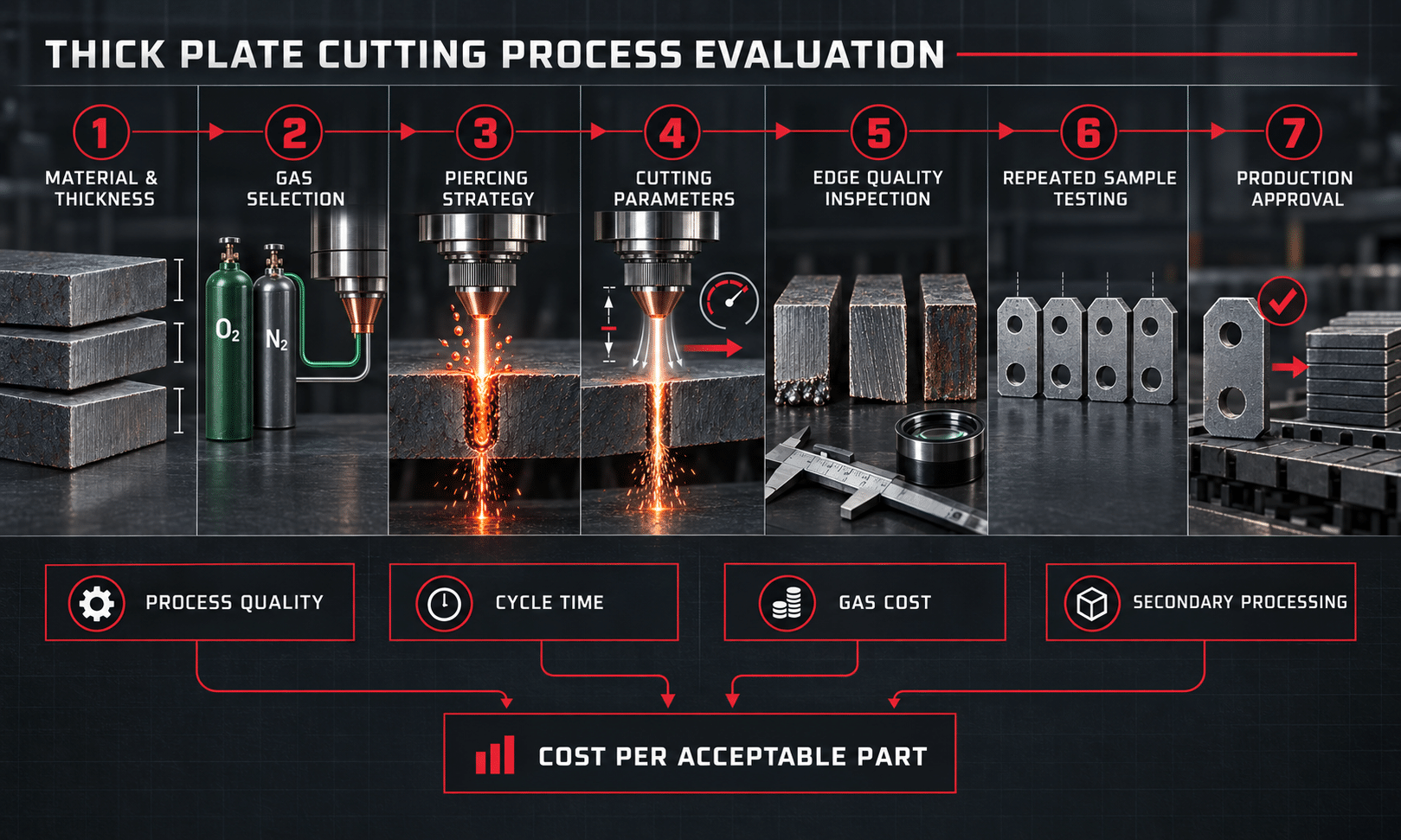
- oxygen vs nitrogen
- piercing strategy
- edge quality
- dross control
- production efficiency
1. Thick Plate Cutting Is a Process System, Not Just a Power Number
Many buyers assume that thick-plate performance depends mainly on kilowatts.
Power matters, but it is only one part of the process.
A successful thick-plate cutting result depends on the interaction of:
- laser source
- beam quality
- cutting head
- nozzle
- focus position
- gas type
- gas pressure
- feed rate
- piercing strategy
- machine stability
- plate condition
This means two machines with the same nominal power may not perform identically on thick steel.
Likewise, increasing power alone does not automatically solve:
- unstable piercing
- rough edge
- heavy dross
- poor hole quality
- inconsistent cut-through
The correct approach is to treat thick plate as a complete cutting process, not as a simple “more power = better cut” equation.
2. What Counts as Thick Steel Plate?
There is no single universal threshold.
In practical laser fabrication, “thick plate” usually means material thick enough that the cutting behavior begins to change noticeably compared with standard sheet processing.
From a process point of view, thicker material typically creates greater demands in:
- pierce time
- heat control
- molten material ejection
- gas consumption
- kerf stability
- taper control
- edge appearance
So for article purposes, “thick steel plate” is best understood as:
steel plate where piercing, gas selection and edge behavior become major process variables rather than minor setup details.
3. Start With the Real Production Requirement
Before discussing oxygen or nitrogen, define the real cutting task.
Important variables include:
- carbon steel grade
- stainless steel grade
- thickness range
- maximum thickness
- edge-quality requirement
- downstream welding requirement
- coating or painting requirement
- hole size
- part geometry
- production volume
For example, one customer may need:
- heavy carbon-steel plate
- moderate cosmetic requirement
- strong focus on speed
Another may need:
- thick stainless steel
- bright edge
- minimal oxidation
- stable hole quality
Those two jobs should not automatically use the same gas or the same process priorities.
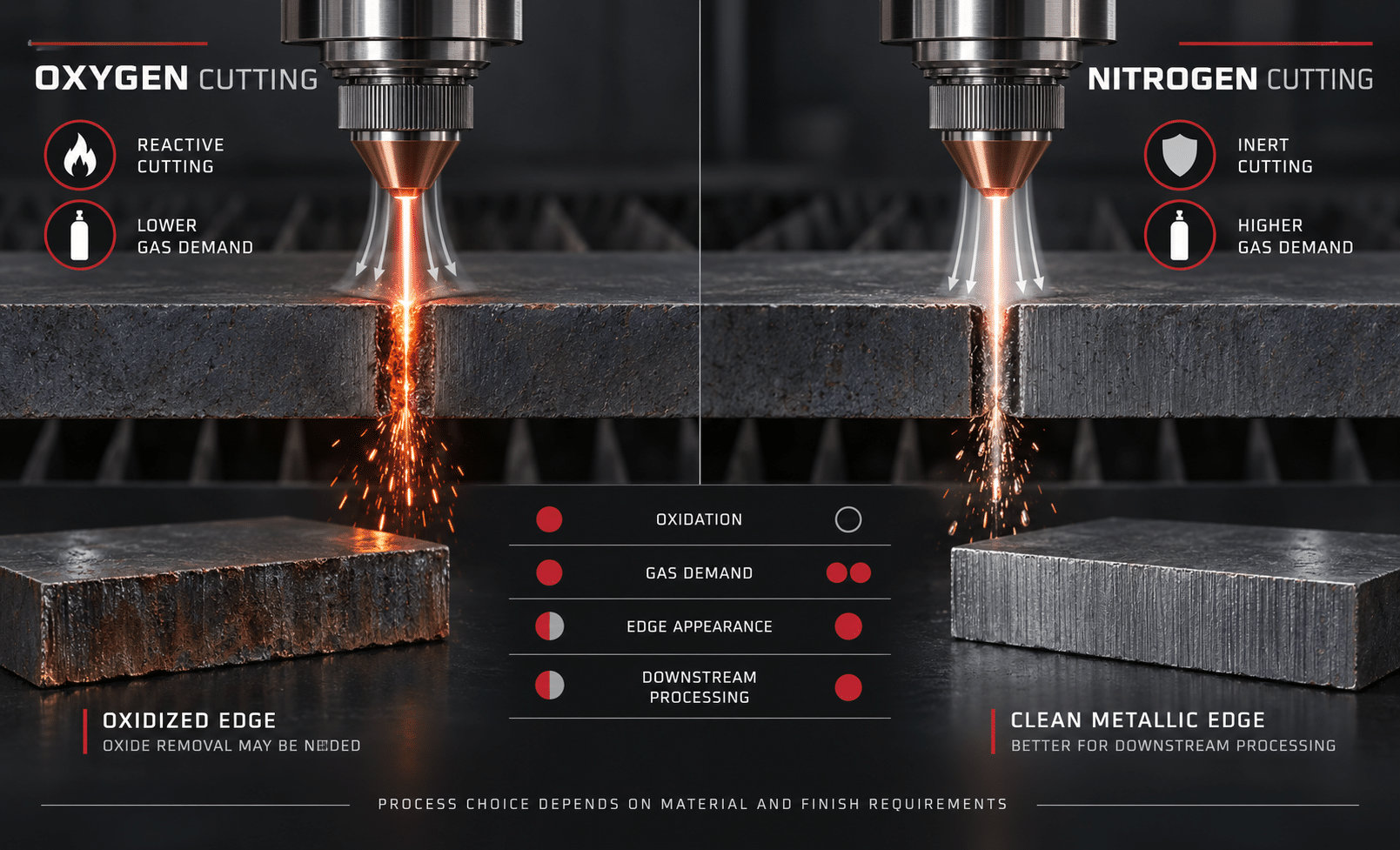
4. Oxygen and Nitrogen Solve Different Production Problems
In fiber-laser cutting, oxygen and nitrogen are not interchangeable “better” or “worse” choices.
They support different cutting behaviors.
A more useful question is:
Which gas best matches the material, edge requirement and production economics of this part?
5. When Oxygen Cutting Makes Sense
Oxygen is commonly used where the process can benefit from the exothermic reaction between oxygen and steel.
That reaction adds heat into the cut.
In practice, oxygen cutting is often attractive because it can support:
- good thick carbon-steel cutting performance
- strong cutting capability on suitable sections
- lower gas consumption cost than high-pressure nitrogen in many cases
- productive cutting of carbon steel where an oxidized edge is acceptable
Oxygen cutting is often chosen when:
- the material is carbon steel
- edge oxidation is acceptable
- the part will not require a bright metallic edge
- downstream painting or welding can tolerate the edge condition
- productivity and operating cost are important
But oxygen cutting also means:
- oxidized cut edge
- possible thicker oxide layer
- different edge appearance from nitrogen
- potential influence on later welding, coating or finishing
So oxygen is often a productive industrial choice, but not automatically the right quality choice for every part.
6. When Nitrogen Cutting Makes Sense
Nitrogen is used as an inert assist gas.
Unlike oxygen, it does not intentionally promote an oxidation reaction in the cut.
That can make nitrogen attractive when the process requires:
- lower-oxidation edge
- cleaner metallic edge appearance
- reduced oxide for later welding or coating
- improved edge cleanliness on selected applications
Nitrogen cutting is often chosen when:
- edge appearance matters
- oxidation must be minimized
- downstream welding is sensitive to oxide
- stainless steel or selected non-carbon materials are involved
- the customer wants a cleaner edge condition
But nitrogen cutting also creates other requirements:
- higher gas pressure in many applications
- higher gas flow demand
- potentially much higher gas operating cost
- stronger dependence on gas infrastructure
So nitrogen may improve edge condition, but it can also significantly increase the cost structure of thick-plate cutting.
7. Oxygen vs Nitrogen: Think in Terms of Trade-Offs
A simple way to explain the difference is this:
Oxygen often prioritizes:
- cutting capability
- productivity on suitable carbon steel
- lower gas cost in many cases
Nitrogen often prioritizes:
- cleaner edge
- lower oxidation
- downstream process friendliness
The correct choice depends on the finished-part requirement.
If the customer says:
“I need the lowest possible oxide because this edge will be welded immediately.”
the answer may differ from a customer who says:
“I need fast thick carbon-steel cutting at reasonable cost.”
This is why gas selection should be driven by part requirement, not just by habit.
8. Thick Plate Cutting Efficiency Often Depends on Piercing
Many people focus on cutting speed but underestimate piercing.
In real thick-plate production, piercing can account for a large portion of cycle time, especially when parts contain:
- many internal contours
- multiple holes
- several separate features
A machine may cut a long outside contour efficiently but still perform poorly in production if each pierce is slow or unstable.
That is why thick-plate optimization should always evaluate:
- piercing time
- piercing stability
- spatter behavior
- lens contamination risk
- transition from piercing to cutting
not just steady-state cutting speed.
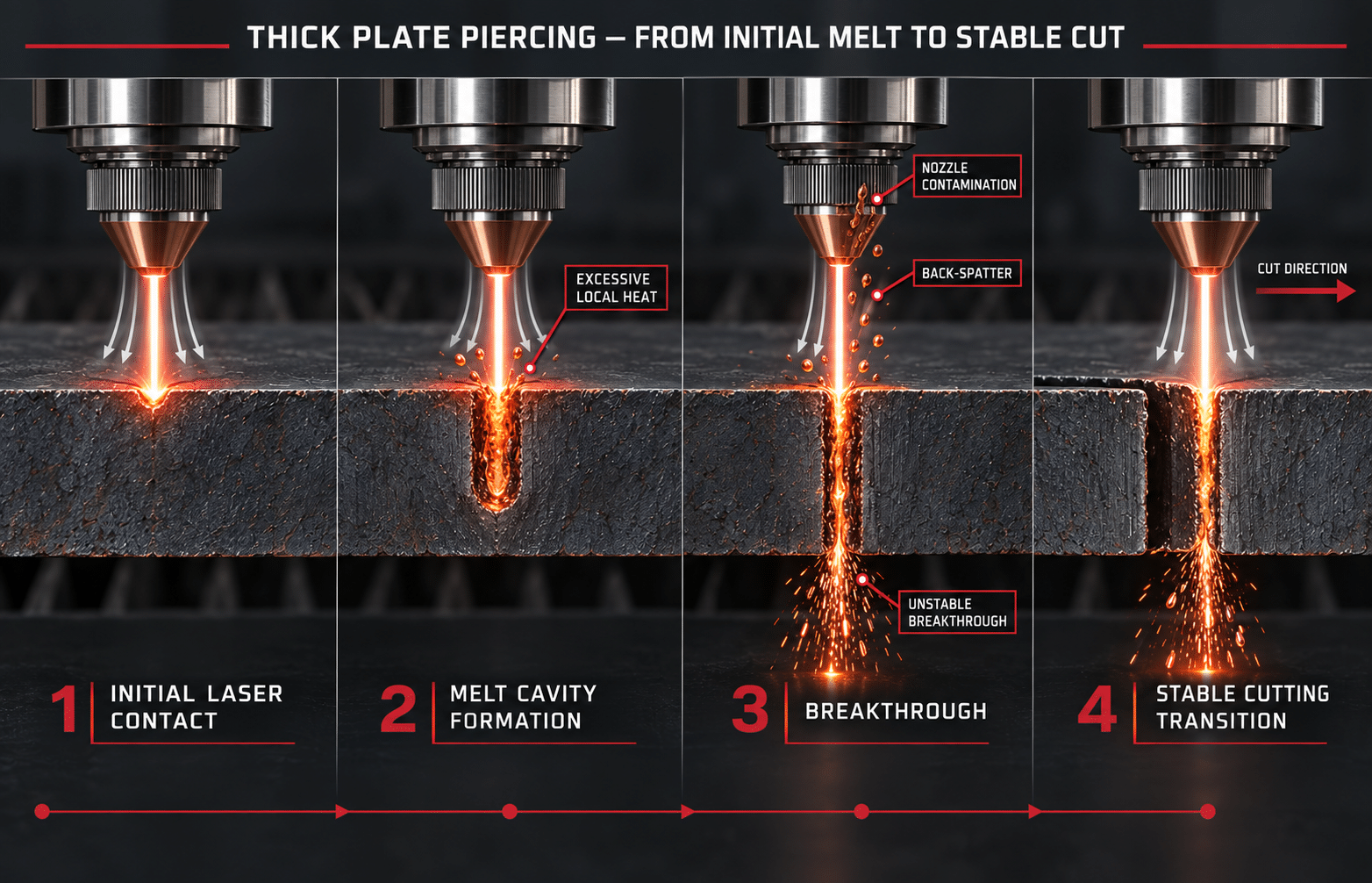
9. Why Piercing Is Harder in Thick Plate
Piercing thick steel requires the beam to penetrate more material before stable cutting can begin.
As thickness increases, piercing becomes more demanding because of:
- larger melt volume
- more heat concentration
- more molten material to eject
- higher chance of back-spatter
- longer dwell time
- greater risk of nozzle contamination
This is one reason why a thick-plate process may appear stable during the cutting path but still perform poorly overall if the pierce stage is not well controlled.
10. The Goal of Piercing Is Not Just to “Get Through”
A successful pierce must do more than open a hole.
It should also:
- protect the cutting head
- minimize spatter
- create a stable start point
- transition cleanly into the cutting path
- avoid excessive local damage
Poor piercing may cause:
- heavy spatter on the nozzle
- contamination of protective optics
- irregular hole entrance
- unstable start of cut
- excess burr or dross near the start point
- scrap adhesion
- process interruption
So when evaluating thick-plate cutting, one of the most useful questions is:
How stable is the pierce—not just how fast is it?
11. Piercing Strategy Should Match the Material and Thickness
There is no single piercing method that suits all thick steel.
The correct strategy depends on:
- steel grade
- thickness
- gas type
- power level
- hole geometry
- edge requirement
In practical production, thick-plate piercing often requires careful balancing between:
- speed
- stability
- optics protection
- cut quality
If the pierce is too aggressive, the process may become unstable.
If it is too conservative, productivity falls sharply.
The best setup is usually the one that achieves reliable repeated piercing with acceptable cycle time, not simply the shortest possible pierce on one demonstration sample.
12. Protecting the Nozzle and Optics Is Part of Thick-Plate Process Control
During thick-plate piercing, spatter and reflected material can increase the risk of contamination.
That can affect:
- nozzle condition
- centering stability
- height sensing
- protective window life
- cut consistency
This is why thick-plate process development should also monitor:
- nozzle wear
- protective lens contamination
- maintenance interval
- cleanliness after repeated piercing cycles
A process that looks acceptable for one part but rapidly contaminates optics may not be production-worthy.
13. Edge Quality Must Be Defined Before It Can Be Improved
“Good edge quality” is too vague to be useful.
Before judging thick-plate results, define what matters most.
Possible edge-quality criteria include:
- smoothness
- verticality
- taper
- dross level
- oxidation level
- striation pattern
- burr
- corner sharpness
- heat effect
- hole entrance/exit quality
Different customers prioritize different outcomes.
For some parts, slight oxidation may be acceptable if the cut is fast and stable.
For others, a cleaner edge may be more important than maximum speed.
So the first rule is:
Define the required edge quality according to the actual application.
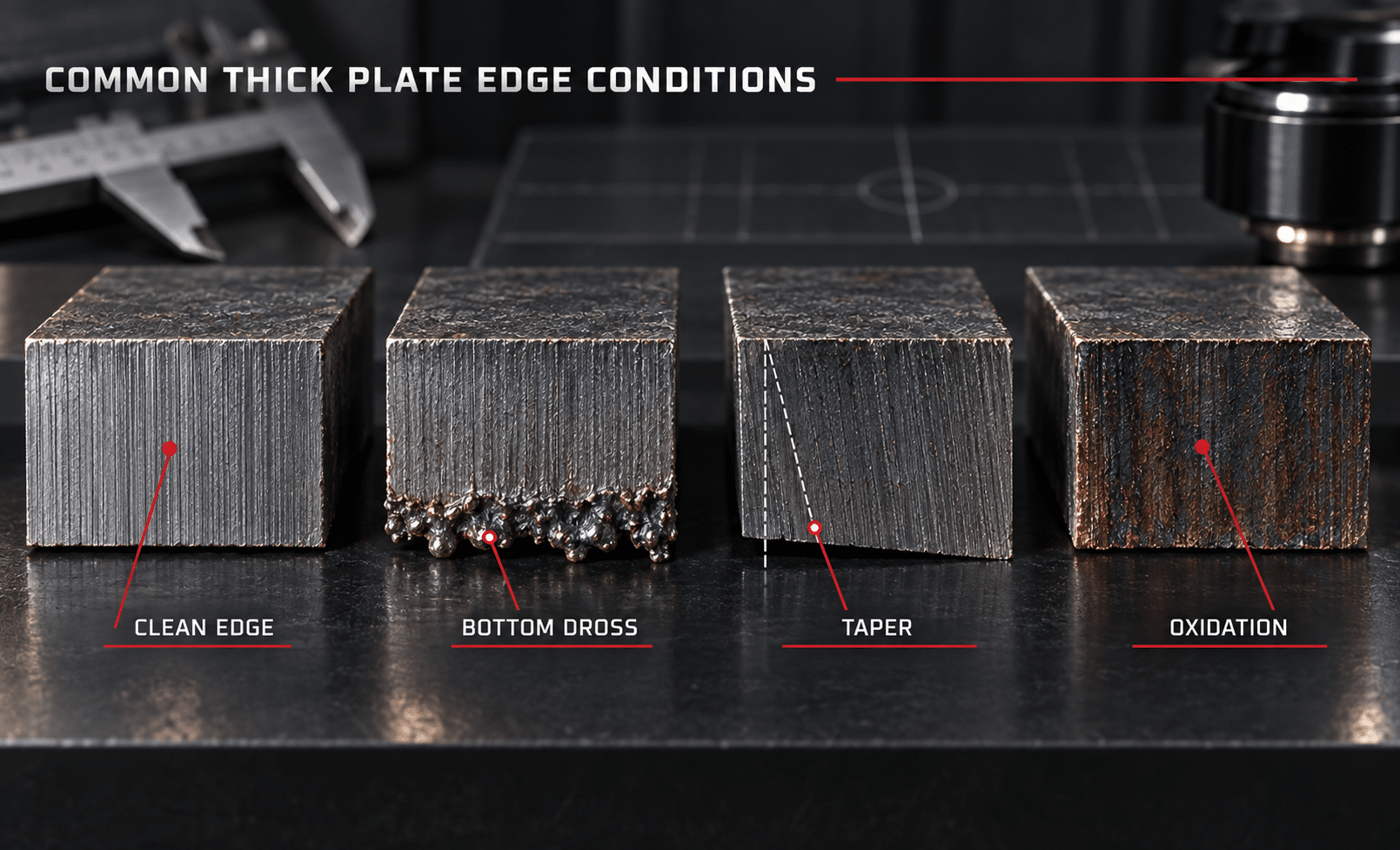
14. What Common Thick-Plate Edge Problems Look Like
Typical issues in thick steel plate cutting include:
Heavy dross
Molten material adheres to the bottom edge instead of being cleanly ejected.
Rough edge
The cut face appears irregular or coarse.
Excessive taper
The kerf is noticeably wider at one side of the thickness than the other.
Oxidized edge
The edge shows a visible oxide layer that may affect downstream processing.
Incomplete cut
Some sections do not fully separate.
Poor hole quality
Roundness, edge cleanliness or entrance/exit condition is unacceptable.
These symptoms do not always have a single cause. They usually reflect the interaction of:
- gas
- focus
- speed
- nozzle
- power
- material condition
- machine motion
15. Dross Control Is One of the Main Thick-Plate Challenges
Bottom dross is one of the most common complaints in thick-plate cutting.
Dross forms when molten material is not cleanly removed from the kerf.
Possible contributors include:
- unsuitable gas condition
- improper speed
- poor focus position
- unstable melt flow
- nozzle condition
- insufficient process margin
- inconsistent plate quality
The practical goal is not just to “cut through,” but to maintain a stable kerf so that molten metal exits the cut rather than reattaching to the lower edge.
This is one reason why thick-plate cutting often requires more process tuning than standard sheet cutting.
16. Focus Position Has a Major Influence on Thick Plate Behavior
As thickness increases, focal setting becomes more sensitive.
Focus position affects:
- energy distribution through the thickness
- kerf behavior
- piercing
- cut-front stability
- edge quality
- dross tendency
A focus setting that works well for one material or one thickness may not work equally well for another.
That is why serious thick-plate process development should record and control focus settings rather than treating them as a secondary adjustment.
17. Nozzle Condition Matters More Than Many Buyers Expect
The nozzle is a process-critical component.
In thick-plate cutting, nozzle condition influences:
- gas flow shape
- kerf evacuation
- process stability
- edge quality
- piercing reliability
A damaged, contaminated or poorly centered nozzle can cause:
- unstable cutting
- poor edge consistency
- incomplete penetration
- increased dross
- irregular hole behavior
So when customers compare machines, they should also compare how stable the process remains in repeated production, not just how one fresh-nozzle demo sample looks.
18. Plate Surface and Material Condition Also Influence Thick-Plate Results
The machine is not the only variable.
Steel plate itself can differ in:
- surface scale
- flatness
- chemistry
- residual stress
- consistency between suppliers
That means process performance may vary if the sample used for testing does not represent actual production material.
For important projects, always test:
- real thickness range
- representative steel grade
- representative supplier material
Do not rely only on an easy lab sample or a generic demo plate.
19. Hole Quality Is Often More Difficult Than Straight-Line Cutting
A thick plate may be easy to cut along a long outside profile but much more challenging in:
- small holes
- narrow slots
- close feature spacing
- dense internal contours
That is why production validation should not use only a large square contour.
The test part should include:
- the smallest required hole
- the tightest feature spacing
- the most difficult internal geometry
- representative pierce count
If hole quality matters, hole performance must be treated as a separate validation target.
20. Thick Plate Cutting Speed Should Be Judged Together With Quality
A faster cut is not automatically a better cut.
When speed is pushed too aggressively, possible results include:
- rough edge
- unstable kerf
- bottom dross
- inconsistent hole quality
- reduced process margin
So the target is not “the highest possible speed.”
The target is:
the highest stable speed that still meets the required edge and part-quality standard.
This distinction is especially important when discussing ultra-high-power systems.
21. Higher Power Can Improve Thick-Plate Productivity—But Only if the Process Is Stable
Higher laser power can help with:
- cutting capacity
- throughput
- pierce performance
- process margin on suitable applications
But thick-plate performance still depends on process setup.
If the process becomes unstable, extra power may simply produce:
- more spatter
- more sensitivity
- higher gas cost
- more difficult control
So the best thick-plate result comes from usable process stability, not just raw available power.
How to Choose a High-Power Fiber Laser Cutting Machine
22. Edge Quality Must Match the Downstream Process
The right cutting result depends on what happens after cutting.
For example:
If the part will be painted:
edge oxidation and cleanup may matter.
If the part will be welded:
oxide condition and cut-face cleanliness may matter more.
If the part is structural but not cosmetic:
speed and stability may matter more than appearance.
If the part needs minimal secondary finishing:
dross control becomes very important.
So thick-plate optimization should always ask:
What does the next manufacturing step require?
That question often determines whether oxygen or nitrogen is the better overall process.
23. Secondary Processing Cost Should Be Included in the Evaluation
A cut edge that looks slightly cheaper during cutting may become expensive later if it requires:
- grinding
- oxide removal
- deburring
- rework
- hole cleanup
Likewise, a more expensive gas process may still be economical if it reduces downstream work.
That is why the right metric is not simply:
gas cost per hour
but rather:
total cost per acceptable finished part
This should include:
- laser process time
- gas
- consumables
- maintenance
- post-processing labor
24. Production Efficiency in Thick Plate Depends on the Whole Cycle
Even though this article focuses on gas and edge quality, thick-plate productivity is still influenced by the full cycle:
- loading
- pallet exchange
- piercing
- cutting
- unloading
- part sorting
A process with excellent cutting speed but slow handling may still underperform.
That is why thick-plate process articles and machine-selection articles should support each other.
High Power Fiber Laser Cutting Machine
25. Thick Plate Fiber Laser vs Plasma: Know When Laser Has the Advantage
For some heavy-plate applications, plasma remains a serious comparison process.
Fiber laser tends to be more attractive where the customer values:
- finer features
- better precision
- smaller holes
- narrower kerf
- cleaner geometry
- higher automation integration
Plasma may remain competitive when the job is dominated by:
- very heavy material
- relatively simple geometry
- lower feature-detail requirement
So if a customer is evaluating thick steel seriously, the discussion should not ignore plasma altogether.
26. What Should Be Tested on a Thick-Plate Sample?
For a serious evaluation, do not test only an easy outer profile.
A representative thick-plate test should include:
- actual steel grade
- typical thickness
- maximum production thickness
- long contour
- small holes
- internal contours
- narrow slot if relevant
- multiple pierces
- representative part geometry
Record:
- pierce time
- cutting time
- gas used
- nozzle condition
- edge appearance
- dross level
- hole quality
- need for secondary cleanup
This gives a much more realistic picture than a simple cut-through demonstration.
27. What Should the Buyer Observe During Testing?
A buyer should not watch only whether the material separates.
Also observe:
- piercing stability
- visible spatter behavior
- nozzle cleanliness after repeated cuts
- consistency between parts
- bottom dross
- hole quality
- edge oxidation
- process interruption
- operator intervention
A machine that can produce one good sample with extensive manual adjustment is different from a machine that can produce repeated samples stably.
28. Comparing Oxygen and Nitrogen in Practice
A very practical evaluation method is to test the same representative part using different validated process setups, where appropriate.
For example, compare:
| Item | Oxygen Process | Nitrogen Process |
|---|---|---|
| Edge oxidation | Inspect | Inspect |
| Dross tendency | Inspect | Inspect |
| Hole quality | Inspect | Inspect |
| Piercing stability | Record | Record |
| Gas cost | Estimate | Estimate |
| Secondary cleanup | Estimate | Estimate |
| Total part cost | Compare | Compare |
This approach is much more useful than arguing from theory alone.
It reveals which process best fits the customer’s actual production priorities.
29. Thick Plate Cutting Should Be Validated Under Repeated Conditions
One good part is useful.
Several repeated parts are more valuable.
Repeated testing helps reveal:
- nozzle contamination trend
- stability of piercing
- consistency of dross level
- part-to-part edge consistency
- whether the process window is robust or very narrow
This is especially important for thick plate, because some processes look acceptable at the beginning but become unstable after repeated pierces or longer operating time.
30. Common Thick-Plate Cutting Priorities by Customer Type
Different buyers often prioritize different outcomes.
Structural fabrication customer
May focus on:
- throughput
- cost
- acceptable edge quality
- reliable thick carbon-steel cutting
Precision fabrication customer
May focus on:
- cleaner edge
- hole quality
- dimensional consistency
- less rework
Heavy industry customer
May focus on:
- plate capacity
- machine uptime
- process stability
- low downtime
Export OEM manufacturer
May focus on:
- repeatability
- multi-material capability
- predictable part quality
- lower secondary finishing cost
This is why thick-plate process advice should always be connected to the real production model.
31. Questions to Ask Before Finalizing the Process
Before confirming a thick-plate fiber-laser solution, ask:
- What material grades will be cut?
- What is the typical thickness, not just the maximum?
- What edge quality is required?
- Is oxidation acceptable?
- Will the cut edge be welded, painted or machined later?
- What is the smallest required hole?
- How many pierces are in a typical part?
- What gas infrastructure is available?
- Is nitrogen cost acceptable for the expected volume?
- How much secondary cleanup is acceptable?
- Has the process been tested on real material?
- Were repeated parts tested, or only one sample?
These questions usually reveal whether oxygen or nitrogen is the better production direction.
32. Thick-Plate Cutting Checklist
Before approving a thick-plate cutting solution, confirm:
- material grade defined
- thickness range defined
- maximum production thickness defined
- edge-quality standard defined
- downstream process requirements defined
- oxygen process tested if applicable
- nitrogen process tested if applicable
- piercing stability observed
- repeated piercing observed
- hole quality checked
- dross level checked
- nozzle condition checked
- optics contamination trend checked
- gas usage estimated
- secondary processing cost estimated
- representative samples cut
- repeated samples checked
- total part cost compared
Conclusion
Cutting thick steel plate with a fiber laser is not only a question of laser power.
The key process decisions usually come down to four areas:
1. Gas selection
Oxygen and nitrogen solve different production problems.
2. Piercing strategy
Piercing often determines real cycle time and process stability.
3. Edge quality control
Thick-plate success depends on more than simply cutting through the material.
4. Production economics
The best process is the one that produces acceptable parts at the lowest total manufacturing cost.
In practice, the most useful engineering principle is:
Choose the gas, piercing strategy and quality target according to the real finished-part requirement—not according to a generic cutting claim.
A well-configured high-power fiber laser can be extremely effective for thick steel plate.
But the final process should always be validated through representative testing of:
- actual steel
- real thickness
- real part geometry
- repeated cutting conditions
Only then can the customer judge whether the process is truly suitable for production.
Optimize Your Thick Plate Cutting Process
Send ZG Laser:
- your steel grade
- thickness range
- part drawing
- edge-quality requirement
- downstream welding or coating requirement
- monthly production volume
Our application team can help evaluate:
- oxygen vs nitrogen process direction
- piercing strategy
- edge-quality target
- machine power range
- sample testing plan
before the final machine configuration is confirmed.
Frequently Asked Questions
Can a fiber laser cut thick steel plate?
Yes, a properly configured fiber laser can cut thick steel plate, but performance depends on more than laser power. Gas choice, piercing method, focus, nozzle condition and part requirement all matter.
Is oxygen or nitrogen better for thick steel plate?
Neither is universally better. Oxygen is often attractive for suitable carbon-steel cutting where edge oxidation is acceptable, while nitrogen is often preferred when a cleaner, lower-oxidation edge is required.
Why is piercing so important in thick plate cutting?
Because thick plate often requires longer and more demanding piercing. In parts with many holes or internal contours, piercing can become a major part of cycle time and process stability.
Does higher laser power automatically improve thick-plate cutting?
Not automatically. More power can improve productivity, but only when the rest of the process is stable. Poor gas setup, unstable piercing or unsuitable parameters can still produce poor results.
What causes dross in thick steel plate laser cutting?
Dross usually appears when molten metal is not cleanly expelled from the kerf. Possible causes include unsuitable gas conditions, speed, focus, nozzle condition or general process instability.
Is edge oxidation always a problem?
No. It depends on the part requirement. For some structural carbon-steel parts, an oxidized edge may be acceptable. For parts that need cleaner welding or coating preparation, it may be undesirable.
What should I test before buying a thick-plate laser machine?
Test real material, typical and maximum thickness, representative part geometry, hole quality, repeated piercing, dross behavior and actual gas/process cost.
Should I compare thick-plate laser cutting with plasma?
Yes. Plasma may still be competitive for some heavy-plate jobs, especially where geometry is simpler and fine-feature quality is less critical.