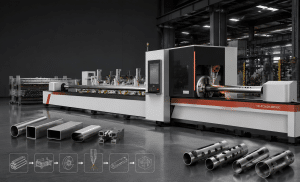
When manufacturers begin comparing laser cutting machines, the first two questions are usually:
- How much laser power does the machine have?
- How much does the machine cost?
Both questions matter, but neither is enough to determine whether a machine will be suitable for your production.
Two laser cutting machines with similar power ratings can perform very differently when processing real parts. Machine architecture, motion control, workholding, software, automation, service support and factory conditions can all affect cutting quality, cycle time and long-term operating cost.
The right machine is not necessarily the one with the highest power or the lowest quotation. It is the machine that can repeatedly process your actual parts at the required quality, speed and cost.
This guide explains how to evaluate an industrial laser cutting machine before making an investment.
1. Start With the Part, Not the Machine
A successful machine selection begins with the workpiece.
Before discussing laser brands, power levels or machine configurations, define what the equipment must produce.
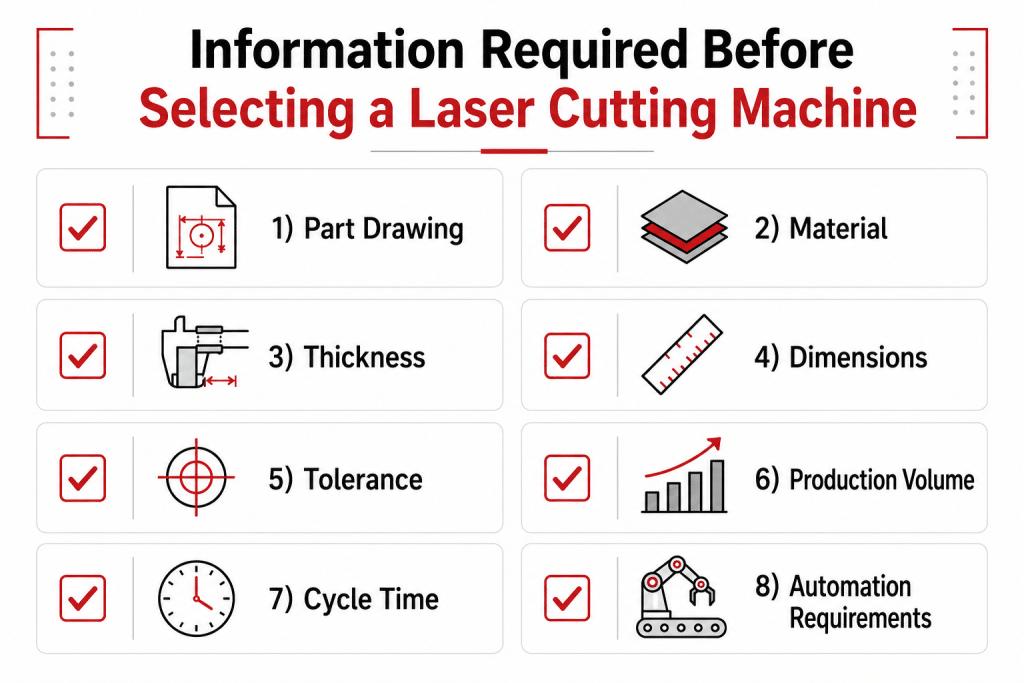
The following information should be collected first:
| Requirement | Questions to Answer |
| Part type | Is the workpiece a flat sheet, tube, profile, structural beam or formed 3D component? |
| Material | Is it carbon steel, stainless steel, aluminum, copper, brass or another material? |
| Thickness | What are the minimum, typical and maximum material thicknesses? |
| Part dimensions | What is the largest workpiece or raw material size? |
| Geometry | Are the cutting paths flat, tubular, angled or three-dimensional? |
| Tolerance | Which dimensions are critical to downstream assembly? |
| Edge quality | How much dross, oxidation or post-processing is acceptable? |
| Production volume | Is the project low-volume, batch-based or continuous mass production? |
| Cycle time | How many parts must be completed per shift? |
| Automation | Is automatic loading, unloading, sorting or fixture changing required? |
A machine should be selected around these requirements—not around the supplier’s standard configuration.
For example, increasing laser power may improve cutting speed on certain thicknesses, but it will not solve a mismatch between the workpiece geometry and the machine architecture. A flat sheet cutting machine cannot replace a true five-axis system when the application requires trimming complex formed parts.
Information to Prepare Before Contacting a Supplier
To receive a meaningful machine recommendation, prepare as much of the following information as possible:
- 2D drawings in DXF or DWG format
- 3D models in STEP, IGES or another common format
- Material grades and thicknesses
- Part photographs
- Annual or monthly production volume
- Required cycle time
- Critical dimensions and tolerances
- Existing production process
- Loading and unloading requirements
- Factory layout and available utilities
A supplier can make a much more accurate recommendation when actual part data is available.
2. Choose the Correct Machine Architecture
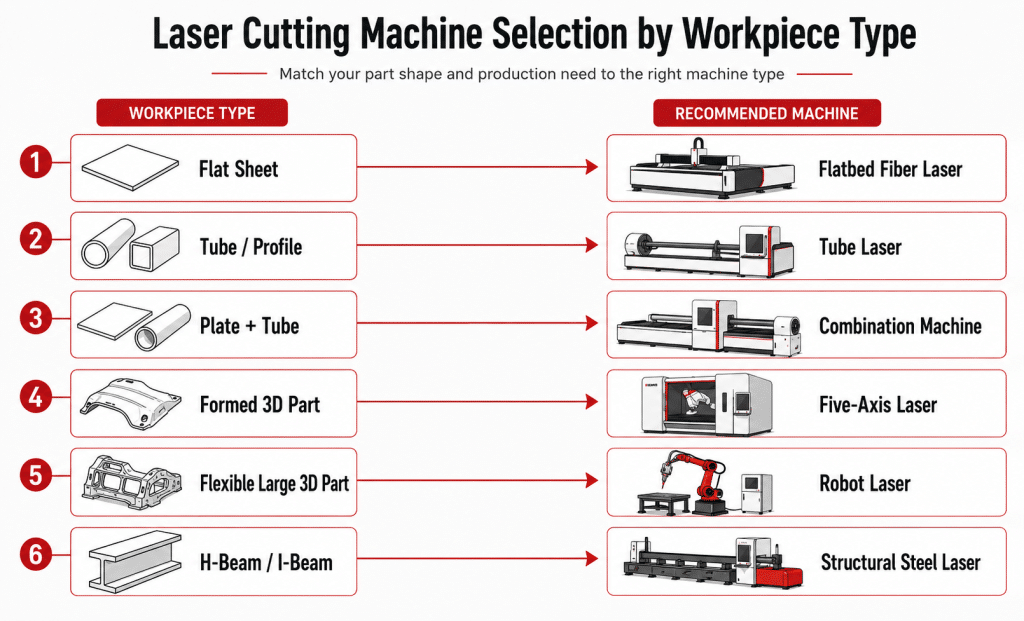
Laser cutting machines are not interchangeable. Each machine architecture is designed for a different type of workpiece and production method.
| Processing Requirement | Recommended Machine Type |
| Flat sheet metal | Flatbed fiber laser cutting machine |
| Thick plates and high-output sheet production | High-power fiber laser cutting machine |
| Round, square or special-shaped tubes | Tube laser cutting machine |
| Both plates and tubes | Tube and plate laser cutting machine |
| I-beams, H-beams and structural profiles | Structural steel laser cutting machine |
| Formed automotive or aerospace components | 3D five-axis laser cutting machine |
| Flexible low-volume three-dimensional parts | Robotic laser cutting system |
Flat Sheet Cutting
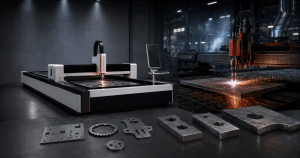
Flatbed fiber laser cutting machines are designed for two-dimensional sheet metal processing. The main selection factors include:
- Working area
- Laser power
- Exchange table configuration
- Loading capacity
- Maximum sheet size
- Automation level
- Assist gas requirements
For high-volume or thick-plate production, buyers should also evaluate cutting head capability, heat management, slag removal, dust extraction and material handling.
Tube and Profile Cutting
Tube laser cutting machines are more suitable for round, square, rectangular, oval and special-shaped profiles.
Important factors include:
- Maximum tube length
- Maximum and minimum diameter
- Chuck design
- Tail material length
- Loading method
- Profile recognition
- Bevel cutting requirements
- Support system for long tubes
Factories that process both sheets and tubes may consider an integrated plate-and-tube system, provided that the production mix and capacity requirements justify the combined configuration.
Three-Dimensional Cutting
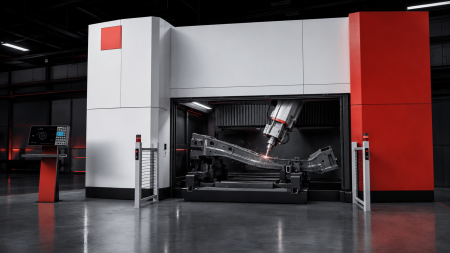
Formed automotive parts, hydroformed tubes, stamped panels and complex three-dimensional components require more than linear X, Y and Z movement.
A dedicated five-axis cutting machine controls both linear and rotary movement so that the cutting head can maintain an appropriate position and orientation along complex three-dimensional paths.
For these applications, the buyer must evaluate:
- X-, Y- and Z-axis travel
- A- and C-axis motion range
- Cutting head accessibility
- Worktable design
- Fixture repeatability
- Offline programming
- Collision avoidance
- Part loading method
- Cycle time consistency
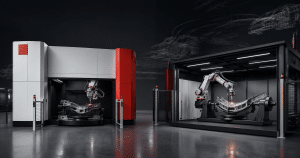
Robotic laser cutting can provide flexibility for large or varied workpieces, while a dedicated five-axis machine may provide a more controlled platform for repeatable production of formed components. The correct choice depends on part size, tolerance, production volume, programming requirements and fixture strategy.
3. Evaluate Real Processing Capability
Machine specifications provide a starting point, but a purchasing decision should not be based on a specification sheet alone.
Maximum speed, maximum acceleration and maximum cutting thickness are usually measured under defined conditions. They do not necessarily represent the machine’s performance on your specific parts.
A more useful evaluation is based on actual processing results.
What to Check During a Sample Cutting Test
Ask the supplier to process your actual material and part geometry whenever possible.
Evaluate:
- Total cycle time
- Piercing time
- Cutting edge condition
- Dross and slag
- Heat-affected area
- Corner quality
- Hole quality
- Dimensional accuracy
- Deformation
- Repeatability between parts
- Loading and unloading time
- Programming and setup time
Do not inspect only the best sample produced during the demonstration. Ask the supplier to run the same part repeatedly and compare the results.
Record the Complete Production Cycle
A short cutting video may show only the laser-on time. In real production, total cycle time can also include:
- Material loading
- Part positioning
- Edge finding
- Piercing
- Cutting
- Table exchange
- Part unloading
- Slag removal
- Fixture change
- Program change
The most important number is not simply cutting speed. It is the number of acceptable parts the complete system can produce per hour or per shift.
Test Your Actual Part Before Selecting a Machine
Send us your drawing, material, thickness and production requirements. Our application team can evaluate the part and recommend an appropriate machine configuration.
4. Understand What Accuracy Specifications Really Mean
Accuracy is one of the most misunderstood areas in laser machine selection.
Several different specifications may be used:
Positioning Accuracy
Positioning accuracy describes how closely an axis reaches a commanded position.
Repeat Positioning Accuracy
Repeat positioning accuracy describes how consistently the axis returns to the same position over repeated movements.
Cutting Accuracy
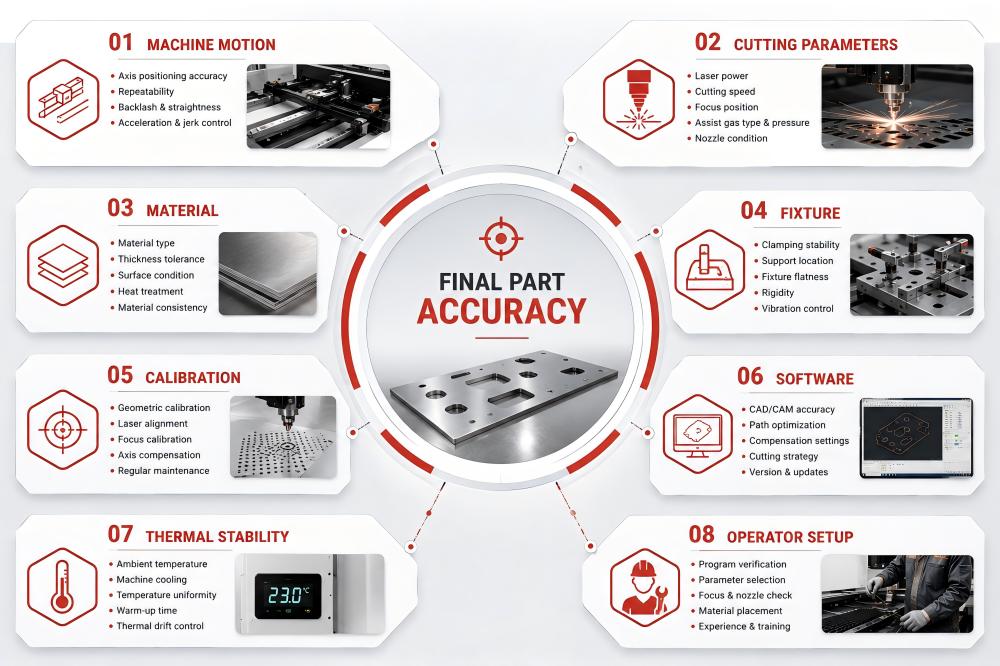
Cutting accuracy is the final dimensional result measured on the workpiece. It can be affected by more than the nominal axis specifications.
Influencing factors include:
- Mechanical accuracy
- Servo control
- Cutting parameters
- Kerf compensation
- Material condition
- Thermal deformation
- Nozzle condition
- Gas pressure
- Focus position
- Workholding
- Part positioning
Fixture Accuracy
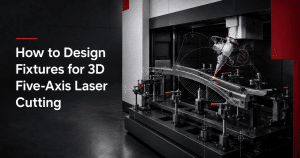
For three-dimensional cutting, the fixture is part of the production system.
Even when the machine axes perform consistently, an unstable or inaccurate fixture can cause unacceptable variation.
The buyer should evaluate:
- Fixture locating points
- Clamping repeatability
- Part deformation during clamping
- Fixture rigidity
- Thermal influence
- Ease of loading
- Quick-change capability
- Fixture inspection method
Rotary-Axis Accuracy
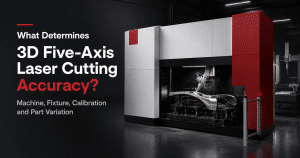
On a five-axis machine, A- and C-axis performance affects the cutting head orientation along the three-dimensional path.
The final result depends on the combined accuracy of:
- Linear axes
- Rotary axes
- Cutting head calibration
- Tool center point calibration
- Fixture position
- Part consistency
- Program accuracy
Therefore, a nominal machine accuracy value should always be verified through actual part testing.
5. Examine the Machine Structure and Motion System
The machine structure affects rigidity, vibration, dynamic response and long-term stability.
However, machine weight alone does not determine quality. A heavier structure is not automatically better if the design, manufacturing process and motion system are poorly matched.
Buyers should evaluate the complete mechanical system.
Machine Bed
Questions to ask include:
- How is the bed manufactured?
- What stress-relief process is used?
- How is the bed machined after welding or casting?
- What foundation is required?
- How is deformation controlled?
- How are rails and racks installed and inspected?
Gantry and Beam
The gantry should provide sufficient rigidity while allowing responsive movement.
A good evaluation should consider:
- Beam material
- Structural design
- Drive arrangement
- Dynamic performance
- Vibration control
- Thermal behavior
- Maintenance accessibility
Transmission Components
Depending on the machine type, the motion system may include:
- Rack and pinion
- Ball screws
- Linear motors
- Servo motors
- Gear reducers
- Linear guides
- Rotary drives
Instead of comparing component brand names alone, ask how the complete motion system is calibrated and tested.
Lubrication and Protection
Inspect:
- Automatic lubrication
- Guide rail protection
- Dust protection
- Cable routing
- Slag protection
- Heat protection
- Access for maintenance
These details may not appear prominently in a quotation, but they influence daily maintenance and equipment reliability.
6. Evaluate the Laser Source, Cutting Head and Control System
The laser source is important, but it is only one part of the machine.
The cutting head, control system, motion platform, process database and software must work together as one system.
Laser Source
Confirm:
- Available power range
- Source warranty
- Service availability in your region
- Cooling requirements
- Electrical requirements
- Compatibility with the intended material and thickness
- Availability of replacement parts
Avoid selecting power only according to the maximum thickness listed in a cutting table. Consider the thickness processed most frequently, the required speed, assist gas cost and edge quality.
Cutting Head
Evaluate:
- Autofocus range
- Height sensing
- Collision protection
- Protective lens design
- Nozzle availability
- Maintenance procedure
- Compatibility with the selected power level
- Stability during piercing and high-speed movement
CNC and Process Software
For flat sheet cutting, the software may include:
- Nesting
- Edge finding
- Common-line cutting
- Micro-joints
- Fly cutting
- Remnant management
- Production reporting
For tube cutting, additional functions may include:
- Profile recognition
- Chuck control
- Tube centering
- Tail material optimization
- Weld seam detection
For three-dimensional cutting, evaluate:
- Offline programming
- 3D path generation
- Coordinate calibration
- Tool center point control
- Collision simulation
- Teaching functions
- Program correction
- Fixture coordinate management
A powerful laser source cannot compensate for software that is difficult to program or unsuitable for the production workflow.
7. Evaluate Workholding, Fixtures and Automation
The laser machine itself may represent only one part of the production cell.
Material handling, fixtures and automation can have a major influence on actual output.
Flat Sheet Systems
Consider:
- Single table or exchange table
- Automatic loading
- Automatic unloading
- Sheet storage
- Part sorting
- Scrap removal
- Pallet exchange time
- Maximum table load
An exchange table can reduce waiting time, but its value depends on whether loading and unloading can keep pace with the cutting cycle.
Tube Cutting Systems
Evaluate:
- Manual or automatic loading
- Tube bundle loading
- Chuck clamping range
- Tube support
- Long-part unloading
- Tail material control
- Finished-part collection
Five-Axis Systems
For complex three-dimensional parts, evaluate:
- Fixed or rotary worktable
- Single-station or multi-station production
- Fixture change time
- Part accessibility
- Loading direction
- Operator access
- Automatic part positioning
- Reserved automation interfaces
Special Considerations for 3D Five-Axis Laser Cutting
Five-axis machine selection should include more than laser power and working envelope.
Review:
- Whether the X/Y/Z travel covers the complete part and fixture
- Whether the A/C-axis motion supports the required cutting angle
- Whether the cutting head can reach recessed or obstructed areas
- Whether the table supports the target production volume
- Whether fixtures can be changed quickly
- Whether offline programming is available
- Whether collision simulation is included
- Whether the machine can support future automation
A rotary table may improve loading efficiency for high-volume production, while a fixed table may be suitable for other part sizes, fixtures or production strategies. The choice should be based on the complete process rather than a single specification.
8. Confirm Safety and Factory Requirements
A laser cutting system must fit the factory environment as well as the workpiece.
Before ordering, confirm all installation requirements.
Safety Configuration
Depending on the machine and application, evaluate:
- Protective enclosure
- Safety interlocks
- Observation windows
- Emergency stop system
- Access doors
- Warning indicators
- Smoke extraction
- Fire prevention
- Operator training
- Personal protective measures
Do not assume that every quotation includes the same safety configuration. Ask the supplier to describe exactly what is included.
Dust and Fume Extraction
Cutting smoke can affect:
- Operators
- Optical components
- Electrical cabinets
- Linear guides
- Factory cleanliness
- Environmental compliance
Confirm:
- Required airflow
- Filter configuration
- Duct layout
- Extraction connection
- Filter replacement intervals
- Responsibility for installation
Utilities
Verify:
- Main power supply
- Voltage and frequency
- Total rated power
- Grounding
- Compressed air
- Nitrogen and oxygen supply
- Gas pressure
- Cooling water
- Workshop temperature
- Humidity
- Foundation
- Crane or forklift requirements
- Machine access route
A detailed factory preparation document should be obtained before shipment.
9. Assess Installation, Training and After-Sales Support
A machine quotation should be evaluated together with the service plan.
Before placing an order, ask:
- Who will install and commission the machine?
- Is on-site training included?
- How many operators can participate?
- What training materials are provided?
- Is remote diagnosis available?
- What response time is offered?
- Which spare parts should be stocked locally?
- Who services the laser source?
- Who services the cutting head?
- Are software updates included?
- What is covered by the warranty?
- What happens after the warranty expires?
- Are electrical drawings and maintenance manuals provided?
The lowest machine price may become expensive if the equipment remains idle while waiting for technical support or spare parts.
Request a clearly written service scope rather than relying only on general promises such as “24-hour support.”
10. Calculate the Total Cost of Ownership
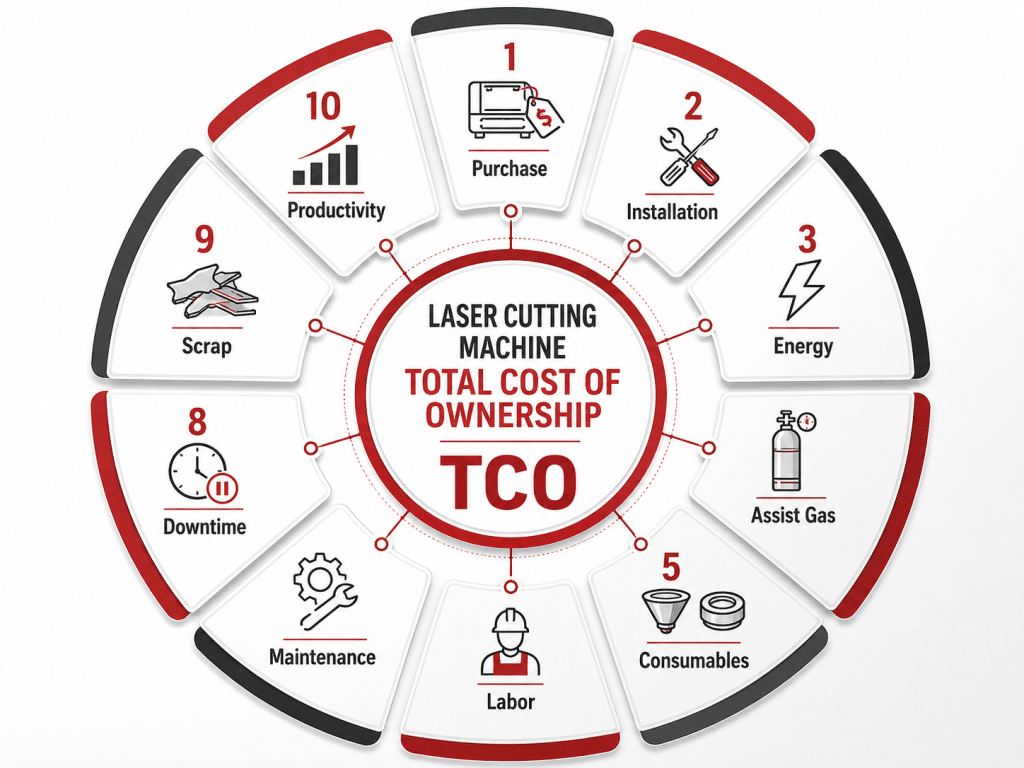
Purchase price is only the initial cost of a laser cutting machine.
A more complete evaluation uses total cost of ownership.
Basic TCO Formula
Total Cost of Ownership = Machine Purchase + Installation + Utilities + Consumables + Maintenance + Labor + Downtime + Financing − Productivity Benefits
The calculation period may be three, five or more years, depending on the company’s investment model.
Initial Costs
Include:
- Machine price
- Optional configurations
- Freight
- Insurance
- Import duty
- Installation
- Factory preparation
- Gas system
- Dust collector
- Chiller
- Transformer
- Fixtures
- Software
- Training
Operating Costs
Include:
- Electricity
- Oxygen
- Nitrogen
- Compressed air
- Protective lenses
- Nozzles
- Ceramic rings
- Filters
- Lubricants
- Replacement parts
- Preventive maintenance
- Operator labor
- Programming labor
Production-Related Costs
Also consider:
- Scrap rate
- Rework
- Secondary deburring
- Setup time
- Fixture change time
- Loading and unloading time
- Unplanned downtime
- Spare-part lead time
A machine with a higher initial price may provide lower long-term cost if it reduces setup, scrap, labor or downtime. However, these benefits should be demonstrated with realistic production data rather than unsupported percentages.
Compare Cost per Acceptable Part
For many factories, the most useful metric is:
Cost per acceptable finished part
This calculation combines:
- Total operating cost
- Parts produced per hour
- Yield rate
- Labor
- Secondary processing
- Downtime
It provides a more practical comparison than purchase price or maximum cutting speed alone.
11. Conduct a Sample Test and Acceptance Test
Sample testing should be completed before the final machine configuration is confirmed.
The acceptance criteria should also be discussed before the machine is manufactured or shipped.
Pre-Purchase Sample Test
A useful sample test should record:
- Material specification
- Material thickness
- Drawing version
- Laser power
- Assist gas
- Gas pressure
- Focus position
- Nozzle size
- Cutting speed
- Piercing method
- Total cycle time
- Inspection results
The sample should represent the actual production requirement—not only a decorative demonstration part.
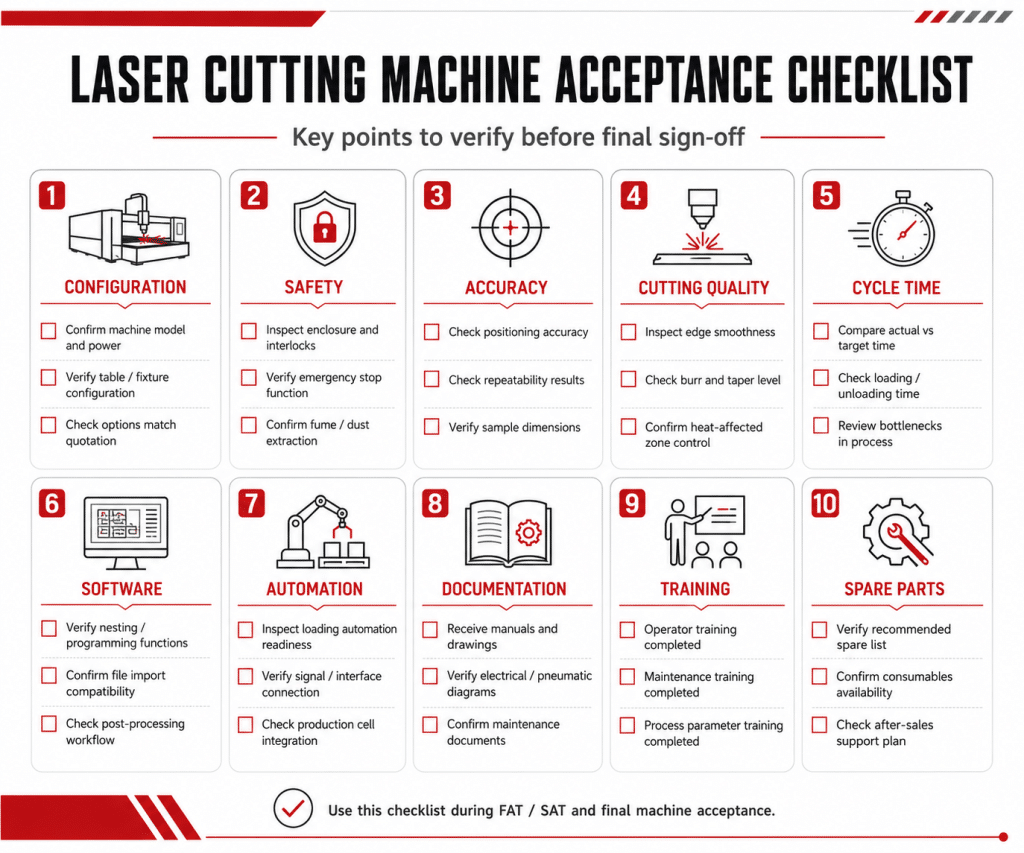
Machine Acceptance Test
A factory acceptance test may include:
- Machine configuration verification
- Axis travel verification
- Safety function test
- Cutting test
- Repeatability test
- Dimensional inspection
- Cycle time verification
- Software function test
- Loading and unloading test
- Fixture test
- Documentation review
- Training confirmation
For five-axis applications, also test:
- Rotary-axis movement
- Tool center point calibration
- Fixture coordinates
- Complex path accessibility
- Collision simulation
- Repeated part loading
- Multi-angle cutting consistency
Repeat the Test
One successful part does not prove production stability.
Where appropriate, process multiple parts under the same conditions and compare:
- Dimensions
- Edge condition
- Cycle time
- Part positioning
- Cutting consistency
The objective is not to create one perfect sample. The objective is to prove that the system can repeatedly produce acceptable parts.
12. Prepare the Right Information for a Quotation
A quotation based only on laser power and table size may not reflect the final project cost.
Before requesting a proposal, provide the supplier with:
- Part drawings or 3D models
- Material types
- Minimum and maximum thicknesses
- Maximum part dimensions
- Required tolerances
- Annual production volume
- Target cycle time
- Loading and unloading method
- Automation requirements
- Available factory space
- Power supply and gas conditions
- Destination country
- Required certifications
- Preferred delivery schedule
- Sample testing requirements
The supplier should then explain:
- Recommended machine architecture
- Recommended laser power
- Working range
- Cutting head configuration
- Control system
- Worktable or fixture design
- Automation options
- Safety configuration
- Installation requirements
- Training plan
- Warranty
- Spare parts
- Delivery time
- Acceptance procedure
A clear technical proposal makes it easier to compare suppliers on equal terms.
Final Evaluation Checklist
Before selecting an industrial laser cutting machine, confirm that you have evaluated:
- The actual part and production requirement
- The correct machine architecture
- Real sample cutting results
- Complete cycle time
- Positioning and cutting accuracy
- Fixture and workholding repeatability
- Machine structure
- Motion components
- Laser source and cutting head
- Software and programming
- Material handling
- Safety and extraction
- Factory utilities
- Installation and training
- Spare parts and service
- Total cost of ownership
- Acceptance criteria
Price and laser power remain important, but they should be evaluated as part of the complete production system.
The best machine is the one that can repeatedly produce acceptable parts, integrate into your factory and support your production targets over the expected service period.
Discuss Your Laser Cutting Project With ZG Laser
ZG Laser provides laser cutting solutions for flat sheets, tubes, structural profiles and complex three-dimensional components.
To receive a machine recommendation, send us:
- Your drawing or 3D model
- Material and thickness
- Part dimensions
- Required production volume
- Target cycle time
- Automation requirements
Our team will review the project and recommend an appropriate machine architecture and configuration.
Explore Laser Cutting Machines
Frequently Asked Questions
Is laser power the most important factor when selecting a laser cutting machine?
Laser power is important, but it should be evaluated together with material, thickness, required speed, machine architecture, cutting head, assist gas, motion system and production volume. Higher power does not solve a mismatch between the machine type and the workpiece.
How can I compare laser cutting machines from different suppliers?
Use the same part drawing, material, thickness, quality requirements and cycle-time definition for every supplier. Compare complete configurations, sample results, automation, service scope, operating cost and acceptance conditions rather than comparing only headline specifications.
Should I request a sample cutting test before buying?
Yes. Sample testing helps verify cutting quality, cycle time, dimensional results and process stability. The test should use your actual material and part geometry whenever possible.
What is the difference between positioning accuracy and cutting accuracy?
Positioning accuracy describes how closely the machine axis reaches a commanded position. Cutting accuracy describes the final dimensional result on the part and can also be affected by material, parameters, calibration, fixtures and thermal conditions.
When is a five-axis laser cutting machine required?
A five-axis machine is generally considered when the workpiece is formed or three-dimensional and the cutting head must approach the part from different angles. Typical examples include hot-formed automotive parts, stamped panels, hydroformed tubes and complex 3D components.
What information is needed to quote a laser cutting machine?
The supplier normally needs drawings, material, thickness, part size, tolerance, production volume, cycle-time requirement, automation needs, factory utilities and destination information. For three-dimensional parts, a 3D model is especially important.