
In today’s advanced industrial landscape, laser cutting and automotive manufacturing have become deeply interconnected, driving unprecedented progress in efficiency, precision, and cost control. A laser is a form of light amplified by stimulated emission of radiation, characterized by exceptional directivity, high brightness, and excellent monochromaticity. These unique properties make lasers widely applicable in a variety of advanced processes, including laser welding, laser engraving, laser drilling, laser marking, and other high-precision fabrication methods. Today, laser-based technologies rank among the most influential and promising innovations in modern industry, reshaping production lines, upgrading product quality, and opening new possibilities for engineering and design.
As the automotive industry moves toward electrification, intelligence, lightweighting, and high customization, traditional manufacturing methods are increasingly unable to meet strict market demands. In this context, advanced photonic technologies have emerged as critical enablers for stable, high-quality, and flexible production. Among these, laser-based processing stands out for its non-contact nature, high accuracy, and strong adaptability to complex materials and shapes.
This article provides a comprehensive, up-to-date analysis of the working principles, core advantages, equipment composition, and practical industrial applications of advanced laser-based cutting solutions in modern vehicle production. By examining real production cases, we illustrate how this technology solves long-standing challenges in component fabrication, improves structural integrity, reduces production costs, shortens development cycles, and supports the sustainable and high-speed development of the global automotive industry.
Principles and Advantages of Laser Cutting
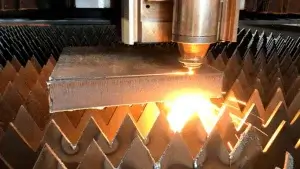
Laser cutting uses a high‑power‑density laser beam to scan the surface of a material, rapidly heating it to thousands or even tens of thousands of degrees Celsius in milliseconds. This extreme heat melts or vaporizes the material instantly, and high‑pressure auxiliary gas then blows the molten or vaporized material away from the kerf, completing the cutting process. Unlike traditional mechanical cutting, stamping, or milling, laser cutting is a non‑contact thermal processing method that brings revolutionary improvements to automotive part fabrication.
The advantages of laser cutting in automotive parts manufacturing are comprehensive and irreplaceable:
-
Ultra‑high precisionThe positioning accuracy can reach approximately 0.05 mm, and in some high‑end configurations, it can be as tight as 0.01 mm, fully meeting the strict tolerance requirements of body structural parts, chassis components, and interior details.
-
Extremely narrow kerfThe laser beam is focused into a tiny spot, creating an ultra‑high power density at the focal point. The material quickly reaches vaporization temperature and forms a micro hole. As the beam moves relative to the material, this hole continuously forms an extremely narrow slit. A narrow kerf reduces material waste, improves part compactness, and supports the production of miniaturized and integrated components.
-
Smooth, burr‑free cutting surfaceThe cut surface is clean, flat, and free of burrs, cracks, or mechanical stress. Most parts require no secondary grinding, polishing, or deburring, directly shortening the process chain and lowering labor costs.
-
Extremely fast cutting speedCutting speed is far higher than that of wire cutting, traditional plasma cutting, or waterjet cutting. For medium‑thickness metal sheets, laser cutting can increase processing efficiency by 30%–200% compared with conventional methods.
-
Excellent cutting quality and minimal thermal impactAs a non‑contact process, laser cutting produces almost no thermal deformation on workpieces. The heat‑affected zone (HAZ) is extremely small, avoiding edge collapse, warping, or material hardening that often occur in stamping and shearing. Most cut joints need no secondary processing.
-
Zero damage to workpiecesThe laser cutting head never touches the material surface, eliminating scratches, indentations, or deformities caused by mechanical contact. This is critical for high‑value, high‑precision automotive components.
-
Unlimited material adaptabilityLaser cutting processes almost all industrial materials regardless of hardness, including carbon steel, stainless steel, aluminum alloy, copper alloy, titanium alloy, cemented carbide, and various high‑strength steels widely used in vehicle safety structures.
-
Superior processing flexibilityLaser cutting is completely unaffected by workpiece shape. It easily cuts flat sheets, pipes, profiles, and complex 3D structural parts. Any 2D or 3D geometry can be realized through programming, supporting highly customized and personalized production.
-
Massive savings on tooling investmentLaser processing requires no molds or dies. There is no mold wear, repair, or replacement, saving huge costs on mold design, manufacturing, storage, and maintenance. This is especially valuable for small‑batch, multi‑variety production.
-
High material utilizationWith computer‑aided nesting and programming, entire sheets can be cut with optimized layouts. Material utilization can exceed 90%, significantly reducing raw material costs for automotive manufacturers.
-
Greatly shortened new product development cyclesNew vehicle model trials typically involve small volumes and complex structures. Laser cutting eliminates mold manufacturing, reduces trial‑production waste, and shortens development cycles by 30%–60%, helping automakers respond faster to market demand.
-
Capability to cut non‑metallic materialsIn addition to metals, laser cutting safely processes plastics, rubber, composites, insulating materials, and interior textiles, supporting the diversified material needs of modern vehicles.
Taken together, laser cutting delivers strong economic and technical viability in automotive production. It is especially suitable for small‑batch workpieces, prototype parts, and complex structural components, providing convenient, cost‑effective solutions for pre‑production research and component development.
Laser Cutting Equipment
The laser cutting equipment used in the automotive industry is diverse and specialized, matching different processing scenarios and part geometries.
- 2D laser cutting machines: Mainly used for flat metal sheets, body panels, chassis bases, and other planar components.
- 3D laser cutting machines: Capable of cutting formed parts in three‑dimensional space, such as door frames, window frames, and body pillars.
- Laser cutting robots: Can handle highly complex 3D workpieces with multi‑angle and multi‑directional cutting requirements.

With the rapid development of the automotive industry—especially the rise of new energy vehicles and intelligent connected vehicles—the application of laser cutting robots is growing rapidly. These systems can handle both flat workpieces and simple 3D parts, making them the most versatile solution in modern automotive workshops.
The following section focuses on the core components of a complete laser cutting robot workstation:
-
High‑precision trajectory robotProvides high‑speed, high‑accuracy 3D motion, supports complex spatial paths, reduces redundant movements, and lowers overall production costs.
-
Laser generatorThe core component that produces the laser source. Common types include solid‑state lasers, gas lasers, and fiber lasers. Fiber lasers are now dominant in automotive applications due to high efficiency, stability, and low maintenance.
-
ChillerProvides real‑time cooling for the laser generator and cutting head, ensuring stable output and extended service life.
-
Optical fiber cableTransmits the laser beam from the generator to the cutting head with low loss and high flexibility.
-
Cutting headIncludes a cavity, focusing mirror holder, focusing lens, capacitance sensor, auxiliary gas nozzle, and other precision parts. It focuses the laser and controls beam quality, standoff distance, and gas flow.
-
WorktableHolds the workpiece and moves precisely along X, Y, Z axes under servo motor drive, synchronized with robot motion.
-
CNC control systemThe “brain” of the workstation. It controls table movement, robot trajectory, laser power, pulse frequency, gas pressure, and other parameters in real time.
-
Operating consoleHuman–machine interface for programming, parameter setting, monitoring, alarm handling, and production management.
-
Gas cylindersIncluding working medium gas and auxiliary gas (oxygen, nitrogen, compressed air) for combustion support, protection, and slag removal.
-
Air compressor and air drying & filtering systemProvides clean, dry, stable compressed air for the pneumatic components and auxiliary gas circuit.
-
Auxiliary equipmentSuch as exhaust fans, dust collectors, and smoke purifiers, ensuring a clean, safe, and environmentally friendly workshop.
Modern laser cutting robot workstations are often equipped with AI‑driven process optimization, automatic fault detection, and digital twin simulation, further improving stability, intelligence, and ease of use.
Practical Applications of Laser Cutting Robots in Automotive Manufacturing
Laser cutting robots are widely used in body‑in‑white, chassis, powertrain, new energy battery structures, and interior parts. Below are two typical and high‑value application cases.
1. Cutting of Pipe Parts
Many automotive components use tubular structures, such as exhaust pipes, seat frames, stabilizer bars, cooling system pipes, and battery tray supports. These parts often require multiple holes of different sizes and positions.

Using traditional mold stamping for such parts has serious drawbacks:
- Complex molds with high development and manufacturing costs
- Large number of molds, increasing investment and management difficulty
- Frequent mold maintenance and replacement, consuming time and labor
- High risk of burrs, deformation, and misalignment, leading to defective products
- Requires dedicated quality inspectors to prevent non‑conforming parts from entering assembly
By contrast, laser cutting completely resolves these pain points and brings clear benefits:
-
Guaranteed part qualityNon‑contact processing eliminates corner collapse, burrs, and deformation. Hole position and diameter accuracy are stable within 0.05 mm, ensuring assembly consistency.
-
Reduced labor and equipment occupancyAfter program setup, only one operator can complete loading, cutting, and unloading. Traditional stamping would require at least 3 sets of molds, 3 operators, and 3 presses.
-
Time savings and ease of operationIn actual production, one robot workstation can cut about 400 pipe parts per day with stable efficiency and low labor intensity. Mold‑based production is prone to delays from mold adjustment, repair, or replacement.
-
Avoidance of missing or wrong cutsThe CNC system automatically detects processing anomalies and triggers an alarm, preventing defective products. Missed punches in stamping are difficult to detect in time and can lead to serious assembly risks and after‑sales losses.
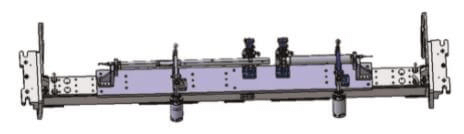
To ensure positioning accuracy, a dedicated part positioning fixture is usually designed. It typically consists of three parts:
- Fixing plate: Secured to the worktable with screws and pins, designed to match table dimensions.
- Positioning unit: Located at the pipe end to ensure accurate hole position relative to the end face.
- Clamping device: Uses four sets of clamping cylinders to secure the part during table rotation and multi‑sided cutting.
This fixture is simple, reliable, low‑cost, and highly practical.
2. Cutting of Profiles
Many automotive components use tubular structures, such as exhaust pipes, seat frames, stabilizer bars, cooling system pipes, and battery tray supports. These parts often require multiple holes of different sizes and positions.
Using traditional mold stamping for such parts has serious drawbacks:

- Complex molds with high development and manufacturing costs
- Large number of molds, increasing investment and management difficulty
- Frequent mold maintenance and replacement, consuming time and labor
- High risk of burrs, deformation, and misalignment, leading to defective products
- Requires dedicated quality inspectors to prevent non‑conforming parts from entering assembly
By contrast, laser cutting completely resolves these pain points and brings clear benefits:
-
Guaranteed part qualityNon‑contact processing eliminates corner collapse, burrs, and deformation. Hole position and diameter accuracy are stable within 0.05 mm, ensuring assembly consistency.
-
Reduced labor and equipment occupancyAfter program setup, only one operator can complete loading, cutting, and unloading. Traditional stamping would require at least 3 sets of molds, 3 operators, and 3 presses.
-
Time savings and ease of operationIn actual production, one robot workstation can cut about 400 pipe parts per day with stable efficiency and low labor intensity. Mold‑based production is prone to delays from mold adjustment, repair, or replacement.
-
Avoidance of missing or wrong cutsThe CNC system automatically detects processing anomalies and triggers an alarm, preventing defective products. Missed punches in stamping are difficult to detect in time and can lead to serious assembly risks and after‑sales losses.

To ensure positioning accuracy, a dedicated part positioning fixture is usually designed. It typically consists of three parts:
- Fixing plate: Secured to the worktable with screws and pins, designed to match table dimensions.
- Positioning unit: Located at the pipe end to ensure accurate hole position relative to the end face.
- Clamping device: Uses four sets of clamping cylinders to secure the part during table rotation and multi‑sided cutting.
This fixture is simple, reliable, low‑cost, and highly practical.
2. Cutting of Profiles
Profile parts are common in vehicle body structures, door frames, roof racks, and battery enclosure frames. A typical case involves cutting two large mounting holes and both ends of a profile with a B‑shaped cross‑section.
Traditional die stamping often causes deformation, especially for thin‑walled and high‑strength profiles. Laser cutting effectively eliminates this issue and ensures dimensional stability.
While cutting holes is relatively straightforward, cutting the profile ends is more challenging:
- The profile has a special B‑shaped section.
- Cutting requires full 360‑degree coverage.
- The cutting head must rotate freely without collision.
If normal direction space is limited, small‑angle cutting paths can be used without affecting part function. The cutting trajectory must be repeatedly simulated and tested to ensure quality, reduce cost, and improve productivity.
The corresponding laser cutting fixture is similar to the pipe fixture and also consists of three parts:
- Fixing plate: Installed in the same way as the pipe fixture for stability.
- Positioning device: Uses hole positioning with a cylinder‑driven movable pin for accurate placement and easy loading/unloading.
- Clamping device: Similar to pipe clamping but with customized clamping heads to match profile shape.
Compared with traditional stamping dies, laser cutting fixtures are simpler, lower‑cost, and faster to deploy. This fully demonstrates that laser cutting robots solve numerous manufacturing problems and create tangible value for automotive parts production.
Conclusion
In summary, laser cutting provides outstanding advantages in automotive processing that align perfectly with the industry’s trend toward cost reduction, quality improvement, lightweight design, and intelligent manufacturing. The application of laser processing robot workstations in the automotive industry has become increasingly widespread, covering not only laser cutting but also laser welding, laser marking, laser engraving, and surface treatment. It is now widely used for both metallic and non‑metallic materials, from body structures to new energy battery components.
As vehicle electrification, intelligence, and lightweighting accelerate, laser cutting will continue to evolve toward higher power, greater precision, stronger flexibility, and deeper integration with AI and digital manufacturing. For automotive manufacturers, adopting advanced laser cutting technology is no longer an option but a necessary strategy to enhance efficiency, lower costs, shorten development cycles, and maintain long‑term competitive advantages in the global market.