Laser power is only one part of a successful laser cutting process.
The gas delivered through the cutting nozzle also plays a major role in determining whether molten material can be removed from the kerf, whether the cutting edge oxidizes, how stable the process remains and how much the finished part will cost to produce.
The most common assist gases used in industrial metal laser cutting are:
- Oxygen
- Nitrogen
- Compressed air
Argon and mixed gases are also used for selected applications.
There is no single “best” assist gas for every laser cutting job.
The correct choice depends on:
- Material
- Thickness
- Laser power
- Required cutting speed
- Edge-quality requirements
- Downstream welding or coating
- Gas pressure and flow
- Gas availability
- Production volume
- Total cost per finished part
TRUMPF distinguishes oxygen-based flame cutting from nitrogen- or argon-based fusion cutting and notes that gas type and pressure directly influence the cutting process and result.
This guide explains how each assist gas works and how manufacturers should compare them in real production.
1. What Does Assist Gas Do in Laser Cutting?
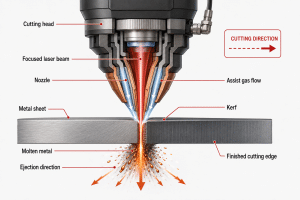
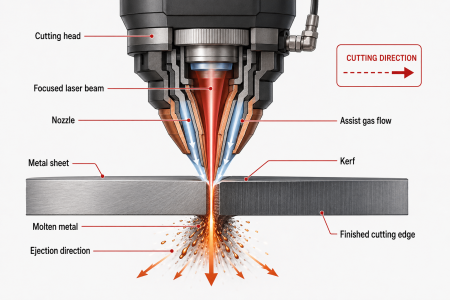
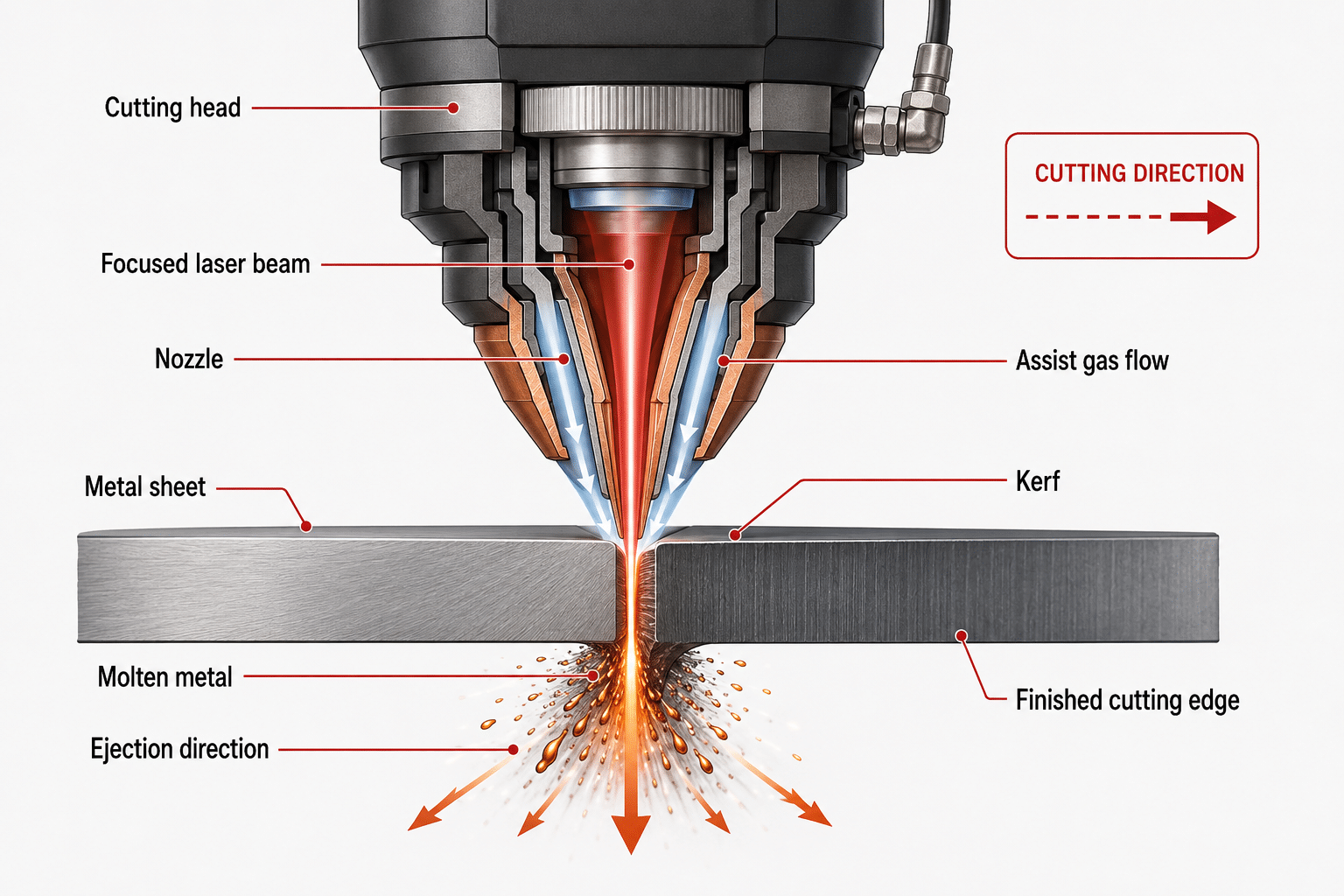
During laser cutting, the focused laser beam heats the material until it melts, burns or vaporizes.
At the same time, gas flows through the cutting nozzle toward the workpiece.
The assist gas can perform several functions.
Remove Molten Material
The gas jet helps eject molten material through the bottom of the cutting kerf.
If the molten material is not removed effectively, the result may include:
- Bottom dross
- Incomplete cutting
- Rough edges
- Unstable cutting
- Recast material
Influence the Chemical Reaction
Some gases actively participate in the cutting process.
Oxygen reacts with hot steel and creates additional heat through oxidation.
Other gases, such as nitrogen and argon, are selected specifically because they are much less reactive with the molten metal during fusion cutting. TRUMPF describes oxygen flame cutting as a reactive process, while nitrogen and argon are used for fusion cutting without intentionally reacting with the molten surface.
Control Edge Oxidation
The selected gas strongly influences the appearance and chemical condition of the cut edge.
This matters when parts will later undergo:
- Welding
- Powder coating
- Painting
- Adhesive bonding
- Corrosion-protection treatment
- Cosmetic finishing
Affect Cutting Stability
Gas conditions influence how efficiently molten material leaves the kerf.
Important variables include:
- Pressure
- Flow rate
- Nozzle diameter
- Nozzle condition
- Nozzle centering
- Stand-off distance
- Gas purity
- Gas supply stability
TRUMPF specifically identifies cutting-gas pressure and nozzle diameter as process parameters that influence cutting results.
Protect the Cutting Area
In inert-gas processes, the gas can also isolate the hot cutting zone from surrounding atmospheric oxygen.
This helps reduce oxidation when a clean metallic edge is required.
2. Oxygen Assist Gas
Oxygen is primarily associated with reactive or flame cutting, particularly when processing carbon and mild steels.
Instead of acting only as a mechanical gas jet, oxygen participates in the cutting reaction.
When oxygen reaches sufficiently heated steel, oxidation generates additional thermal energy that supports material removal.
Advantages of Oxygen Cutting
Additional Cutting Energy
Because oxidation contributes energy to the process, oxygen can be effective for suitable carbon-steel applications.
This becomes especially relevant when processing certain medium or thicker steel sections.
Lower Gas Flow Requirements in Some Processes
Oxygen cutting generally operates differently from high-pressure nitrogen fusion cutting.
The exact pressure must always come from the validated process database rather than a universal value.
Established Carbon-Steel Process
Oxygen cutting has long been used for mild steel and remains an important production process even as fiber-laser power increases.
Limitations of Oxygen
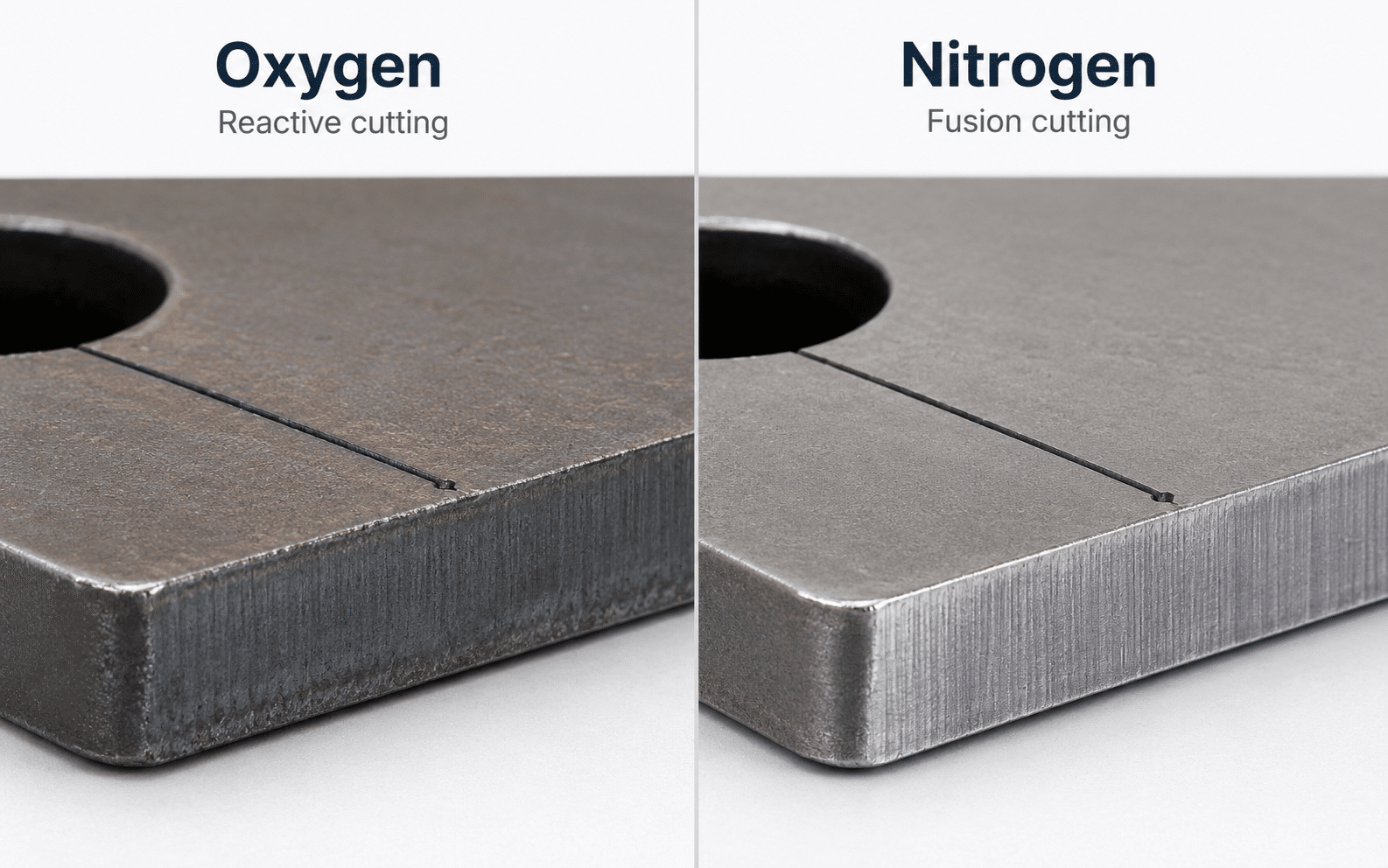
The most important disadvantage is oxidation of the cut edge.
After oxygen cutting, the edge normally develops an oxide layer.
This can matter if the part will later be:
- Powder coated
- Painted
- Adhesively bonded
- Welded under demanding specifications
- Used where cosmetic edge appearance matters
Bystronic notes that one reason manufacturers select nitrogen instead is to avoid the oxidized edges created during oxygen cutting, particularly where downstream coating is important.
Possible Additional Processing
Depending on the product specification, oxygen-cut parts may require:
- Grinding
- Brushing
- Sanding
- Blasting
- Chemical preparation
Therefore, the lower cutting-gas cost should not be evaluated separately from downstream processing cost.
When Should Oxygen Be Considered?
Oxygen may be a suitable starting point when:
- The material is carbon or mild steel
- Some edge oxidation is acceptable
- Thick-section cutting is required
- Downstream processing can tolerate the oxide layer
- The tested process provides acceptable productivity
- Total cost per finished part is competitive
It should not automatically be selected simply because the material is carbon steel.
A customer may still prefer nitrogen or another process if oxide-free edges are important.
3. Nitrogen Assist Gas
Nitrogen is commonly used for fusion cutting.
The laser melts the material, while the nitrogen jet removes the molten metal from the kerf without intentionally creating the oxidation reaction used in oxygen cutting.
This makes nitrogen especially useful when the condition of the finished edge matters.
Main Advantages of Nitrogen
Low-Oxidation Cutting Edge
Nitrogen helps produce a metallic edge with significantly less oxidation than oxygen cutting.
This can be particularly useful for:
- Stainless steel
- Aluminum
- Painted components
- Powder-coated components
- Parts going directly to welding
- Decorative metal products
- Food-processing equipment
- Architectural components
Reduced Downstream Edge Preparation
When the cutting result satisfies the next manufacturing process, manufacturers may be able to reduce operations such as:
- Grinding
- Oxide removal
- Edge cleaning
- Surface preparation
However, this must be verified according to the customer’s actual coating, welding or corrosion specification.
Suitable for Several Non-Ferrous Metals
Nitrogen is frequently used with:
- Stainless steel
- Aluminum
- Certain copper alloys
- Other materials where oxidation should be minimized
The correct process still depends on laser source, cutting head, material composition and thickness.
Main Limitation: Gas Consumption
Nitrogen cutting often requires substantial gas flow.
As laser power and cutting capacity increase, the gas-supply system becomes an increasingly important part of the overall investment.
Bystronic highlights rising nitrogen consumption as one of the operational considerations associated with high-power fiber-laser production.
A buyer should therefore evaluate:
- Gas price
- Gas delivery
- Storage
- Pipeline capacity
- Flow
- Peak consumption
- Supply pressure
- Production shifts
A machine may cut extremely fast while still producing a high cost per part if gas infrastructure is poorly planned.
4. Compressed Air for Laser Cutting
Compressed air provides another assist-gas option for suitable fiber-laser applications.
Ambient air contains primarily nitrogen and oxygen, along with smaller quantities of other gases. Once compressed, dried and filtered to the required standard, it can serve as a laser cutting gas on compatible machines.
Some industrial fiber-laser systems explicitly support compressed-air cutting. For example, TRUMPF has documented compressed air as an available cutting-gas option on selected systems, although applicable material and thickness depend on machine configuration and laser output.
This is important:
Compressed air cutting capability should never be generalized from one machine to every fiber laser.
The actual process must be tested.
Why Manufacturers Consider Compressed Air
Lower Purchased Gas Dependence
If a factory produces suitable high-pressure compressed air internally, it may reduce dependence on purchased nitrogen or oxygen.
Potential Operating-Cost Advantage
The economics depend on:
- Electricity cost
- Compressor efficiency
- Required pressure
- Required air volume
- Filter replacement
- Dryer maintenance
- Compressor maintenance
- Operating hours
“Air is free” is therefore misleading.
The atmospheric air itself is free, but producing clean, dry, high-pressure air is not.
Convenient Factory Supply
For factories that already have suitable compressor infrastructure, air may simplify gas logistics.
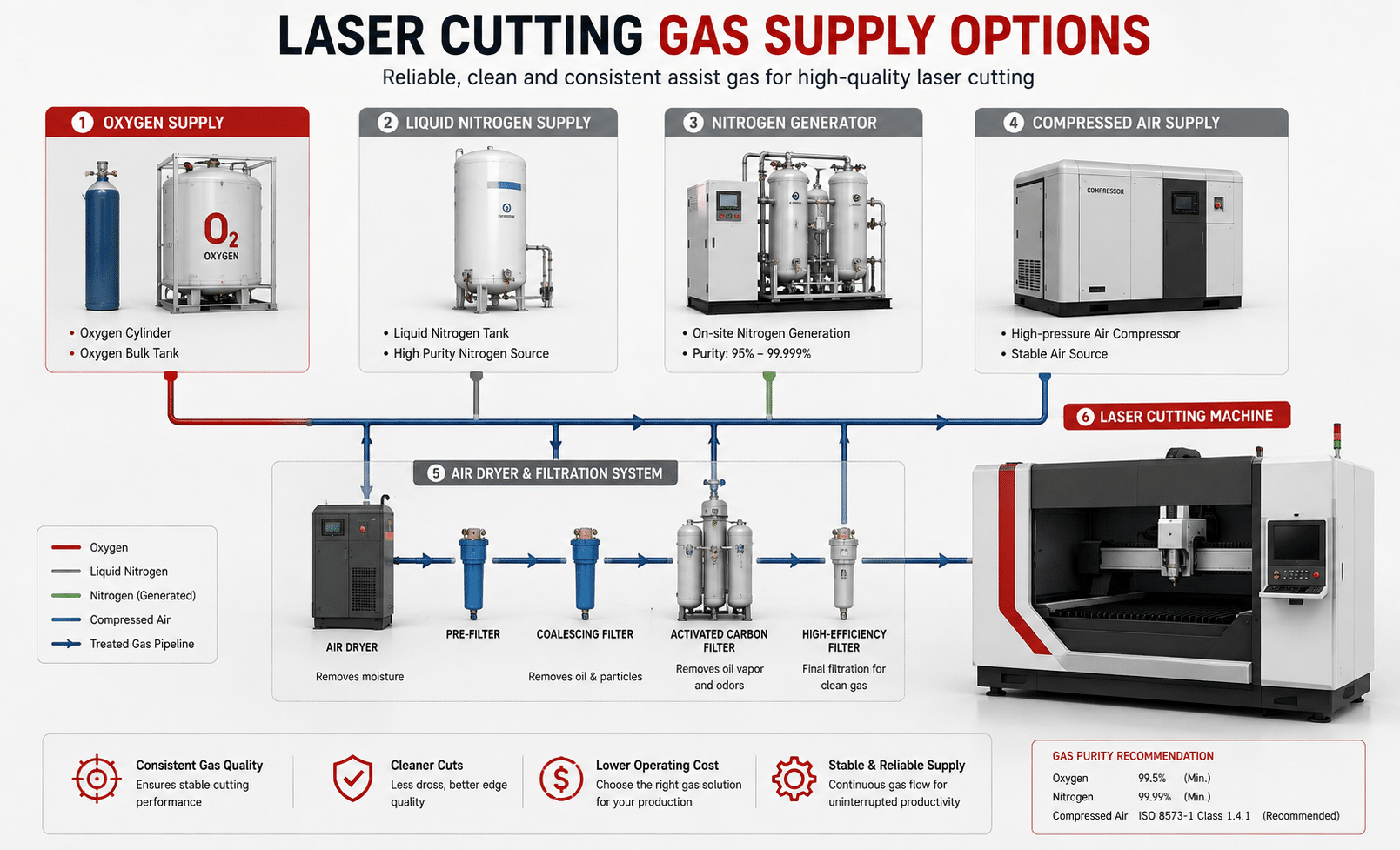
5. What Does a Laser Cutting Air System Require?
An ordinary workshop compressor should not automatically be connected to a laser cutting machine.
The air system may need:
- Compressor
- Air receiver
- Dryer
- Fine filters
- Oil removal
- Moisture separation
- Pressure control
- Adequate pipe diameter
- Stable high-flow delivery
Moisture Control
Water in the gas system can affect:
- Cutting stability
- Gas components
- Valves
- Optical-system protection
- Long-term equipment reliability
Oil Control
Oil contamination can be particularly problematic around high-pressure gas and optical equipment.
The compressor and filtration configuration should comply with the laser manufacturer’s requirements.
Flow and Pressure Stability
A compressor capable of reaching a specified pressure does not necessarily have enough flow to maintain that pressure during continuous cutting.
Always ask:
- Required pressure?
- Required Nm³/h or equivalent flow?
- Peak consumption?
- Compressor duty cycle?
- Required air purity?
- Required dew point?
- Required filtration class?
The answers should come from the machine configuration and validated process—not from a generic compressor supplier alone.
6. Oxygen vs Nitrogen vs Compressed Air
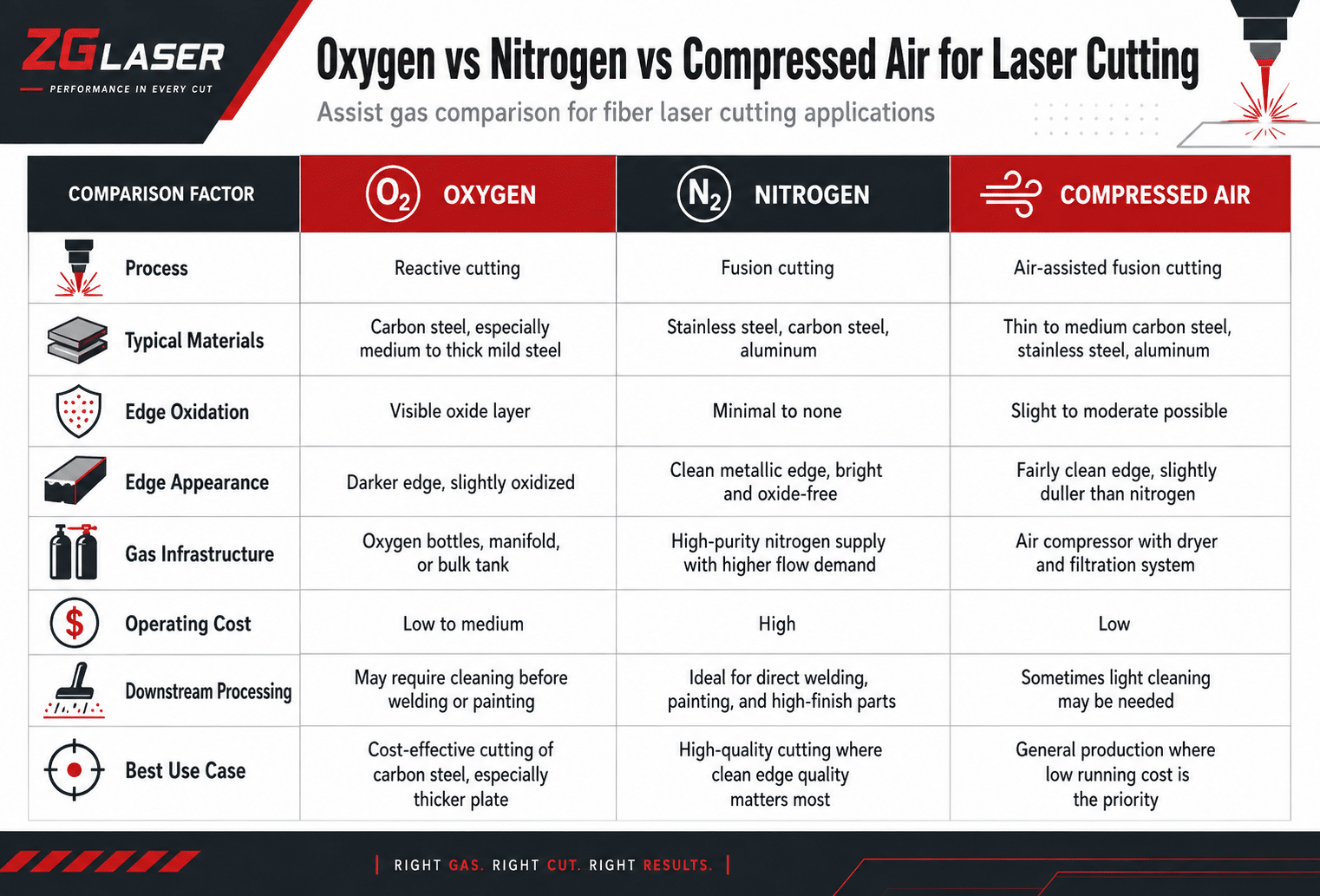
The following table gives a practical comparison.
| Factor | Oxygen | Nitrogen | Compressed Air |
|---|---|---|---|
| Main process principle | Reactive cutting | Fusion cutting | Mixed-gas cutting behavior |
| Common material focus | Carbon / mild steel | Stainless, aluminum, clean-edge steel | Suitable steel, stainless and aluminum applications |
| Edge oxidation | High relative to nitrogen | Low | Moderate / application-dependent |
| Purchased gas cost | Often relatively controlled | Can be significant | May reduce purchased-gas dependence |
| Gas infrastructure | Oxygen supply | High-flow nitrogen supply | High-pressure compressor + treatment |
| Downstream coating | Oxide may require consideration | Often advantageous | Must be validated |
| Edge appearance | Oxidized | Cleaner metallic edge | Depends strongly on process |
| Best selection criterion | Actual production result | Actual production result | Actual production result |
This should not be published as a universal material-thickness capability table.
Thickness limits vary too much with:
- Laser power
- Beam properties
- Cutting head
- Nozzle
- Material grade
- Surface condition
- Gas pressure
- Required edge quality
7. Which Assist Gas Should Be Used for Carbon Steel?
Carbon steel offers the widest range of practical choices.
Depending on thickness, laser power and edge requirements, manufacturers may evaluate:
- Oxygen
- Nitrogen
- Compressed air
- Specialized gas mixtures
Oxygen for Carbon Steel
Oxygen remains an established process when:
- An oxidized edge is acceptable
- The material and thickness respond well to reactive cutting
- Production economics favor oxygen
- Downstream processing can handle the oxide
Nitrogen for Carbon Steel
Nitrogen may be considered when:
- A low-oxidation edge is required
- Parts proceed directly to coating or welding
- High-power fiber cutting provides suitable productivity
- Additional gas consumption is economically acceptable
Compressed Air for Carbon Steel
Air can be evaluated when:
- The machine supports it
- The material/thickness is within the tested process range
- Edge appearance is acceptable
- Compressor economics are attractive
Do Not Decide by Material Name Alone
Two carbon-steel projects can require different gases because one component may be:
cut → welded → painted
while another may be:
cut → deburred → assembled internally
Their acceptable edge conditions may be completely different.
8. Which Gas Is Best for Stainless Steel?
Nitrogen is commonly selected for stainless steel because it helps maintain a low-oxidation metallic edge.
TRUMPF describes nitrogen and argon as inert cutting gases used in fusion cutting specifically to avoid reaction with molten material in the kerf.
This can be particularly valuable for:
- Food-processing equipment
- Kitchen equipment
- Architectural stainless
- Electrical enclosures
- Decorative components
- Medical-equipment structures
Compressed air can also be evaluated for suitable stainless-steel applications when:
- Slight oxidation or edge coloration is acceptable
- Production cost is critical
- The cutting system supports air
- Actual sample tests meet quality requirements
Oxygen is generally less attractive when preserving stainless appearance and corrosion behavior is important.
9. Which Gas Is Best for Aluminum?
Nitrogen is widely considered where a low-oxidation aluminum edge is required.
But aluminum laser cutting also depends heavily on:
- Alloy
- Thickness
- Laser power
- Beam characteristics
- Dross behavior
- Surface film
- Nozzle configuration
Compressed air may also be viable in suitable production conditions.
The decision should therefore be based on sample testing rather than a simple rule such as:
“Aluminum = nitrogen.”
For high-power systems, some manufacturers also offer controlled nitrogen/oxygen gas-mix technologies to influence burr behavior and process stability. TRUMPF currently offers integrated nitrogen/oxygen gas mixing on selected high-power machines, while Bystronic documents the use of gas mixtures for improving particular high-power cutting processes.
10. Why Does Edge Oxidation Matter?
Assist gas selection should consider what happens after laser cutting.
This is one of the most important purchasing considerations.
Powder Coating
An oxide layer may interfere with preparation and adhesion depending on the coating process.
If parts go directly from cutting to powder coating, test:
- Oxygen-cut edge
- Nitrogen-cut edge
- Air-cut edge
under the real coating process.
Painting
Evaluate:
- Edge preparation
- Adhesion
- Corrosion test requirements
- Pretreatment process
Welding
Edge oxidation can influence:
- Joint preparation
- Process cleanliness
- Weld consistency
The required preparation depends on the welding process and engineering specification.
Adhesive Bonding
Automotive, transportation and equipment manufacturing increasingly use structural adhesives.
Bonding surfaces should meet the adhesive manufacturer’s preparation requirements.
Appearance
Decorative stainless or aluminum may require cleaner edge appearance than internal structural components.
Therefore:
The cheapest cutting process is not necessarily the cheapest manufacturing process.
11. Gas Purity, Pressure and Flow Matter
Selecting “nitrogen” or “oxygen” is not enough.
Process performance also depends on gas quality and delivery conditions.
Gas Purity
Different applications may specify different purity levels.
Higher purity can increase gas cost, so the required specification should be based on actual cutting and downstream requirements.
Do not assume:
higher purity is always economically better.
Gas Pressure
Pressure affects the ability of the gas jet to remove molten material.
TRUMPF’s general process description illustrates that oxygen flame cutting and nitrogen fusion cutting operate under different gas-pressure regimes, which is one reason the two processes need different gas infrastructure.
However, do not take a generic pressure value from an online article and manually enter it into a production machine.
Use:
- Manufacturer process data
- Machine parameter database
- Sample testing
- Application-engineer recommendations
Gas Flow
Gas consumption depends on more than pressure.
Important variables include:
- Nozzle diameter
- Nozzle design
- Pressure
- Material thickness
- Cutting time
- Piercing strategy
- Machine utilization
A larger nozzle or higher-pressure process can dramatically change gas demand.
12. Gas Supply Options
The cutting machine is only one part of the gas system.
Cylinder Supply
May be suitable for:
- Sample testing
- Low consumption
- Backup supply
- Small-volume production
Limitations can include:
- Frequent bottle changes
- Pressure variation
- Handling
- Logistics
Liquid / Bulk Supply
Can support higher-volume production.
Evaluate:
- Supplier contract
- Tank capacity
- Delivery frequency
- Evaporation
- Pipe capacity
- Factory space
- Local regulations
On-Site Nitrogen Generation
Instead of receiving nitrogen from a gas supplier, some factories produce nitrogen on site from compressed atmospheric air.
TRUMPF describes a configuration where compressed air is processed to remove oxygen, after which nitrogen is compressed and stored for laser cutting.
Bystronic also identifies nitrogen generation as an increasingly important consideration for high-power laser operations with high nitrogen consumption.
An on-site generator should be evaluated according to:
- Required nitrogen purity
- Required flow
- Required pressure
- Compressor energy
- Production hours
- Maintenance
- Capital investment
- Backup supply
It is not automatically cheaper in every factory.
13. What About Nitrogen and Oxygen Gas Mixtures?
Modern high-power laser cutting has created another option:
controlled gas mixtures.
Rather than choosing only pure nitrogen or oxygen, selected systems mix controlled amounts of the two.
The objective can include:
- Managing burr formation
- Improving process stability
- Increasing productivity in selected materials
- Reducing dependence on pure nitrogen
TRUMPF currently offers integrated nitrogen/oxygen gas mixing on selected high-power systems and notes potential improvements in burr behavior depending on the material and alloy.
Bystronic has similarly reported that controlled nitrogen/oxygen mixtures can improve some high-power cutting applications, while emphasizing that results vary with machine and application.
Important Limitation
A gas mixture is not simply a DIY combination of oxygen and nitrogen bottles.
A properly designed system requires:
- Compatible machine process
- Controlled gas ratios
- Correct pressures
- Suitable mixer
- Validated cutting parameters
- Safety controls
And because oxygen is present, downstream oxidation and corrosion requirements must still be evaluated.
14. How to Calculate Assist-Gas Cost
A buyer should not compare gas by price per cylinder alone.
A better model is:
Assist Gas Cost per Part = Gas Consumption per Hour × Gas Cost ÷ Acceptable Parts per Hour
Then include related costs.
For nitrogen:
- Gas purchase
- Delivery
- Storage
- Tank rental
- Pipeline
- Evaporation
- Generator electricity, if applicable
For compressed air:
- Electricity
- Compressor
- Dryer
- Filters
- Maintenance
- Storage
- Pipeline
For oxygen:
- Gas cost
- Delivery
- Storage
- Possible downstream oxide removal
Example Decision Logic
Imagine Process A costs less during laser cutting but requires:
- Edge grinding
- Extra labor
- Longer coating preparation
while Process B uses more expensive gas but produces a part that can move directly to the next operation.
Process B may have the lower finished-part cost.
15. Common Assist-Gas Problems
| Problem | Possible Gas-Related Cause |
|---|---|
| Heavy bottom dross | Insufficient flow, incorrect pressure or nozzle issue |
| Incomplete cutting | Poor molten-material removal or unstable gas supply |
| Excessive oxidation | Gas selection, contamination or insufficient inert-gas protection |
| Uneven edge | Nozzle misalignment or unstable gas jet |
| Different quality across sheet | Pressure variation, nozzle damage or material variation |
| High gas consumption | Oversized nozzle, excessive pressure or gas leak |
| Unstable piercing | Gas timing, pressure or nozzle problem |
| Edge discoloration | Oxidation or inappropriate gas/process combination |
| Poor coating adhesion | Edge oxide or inadequate surface preparation |
| Compressor unable to maintain pressure | Insufficient flow capacity |
Do not immediately increase pressure whenever cutting quality deteriorates.
First inspect:
- Nozzle condition
- Nozzle centering
- Protective lens
- Stand-off height
- Gas pressure
- Gas supply
- Material
- Focus
- Cutting speed
- Parameter database
Laser cutting is a system. A gas symptom can have a non-gas root cause.
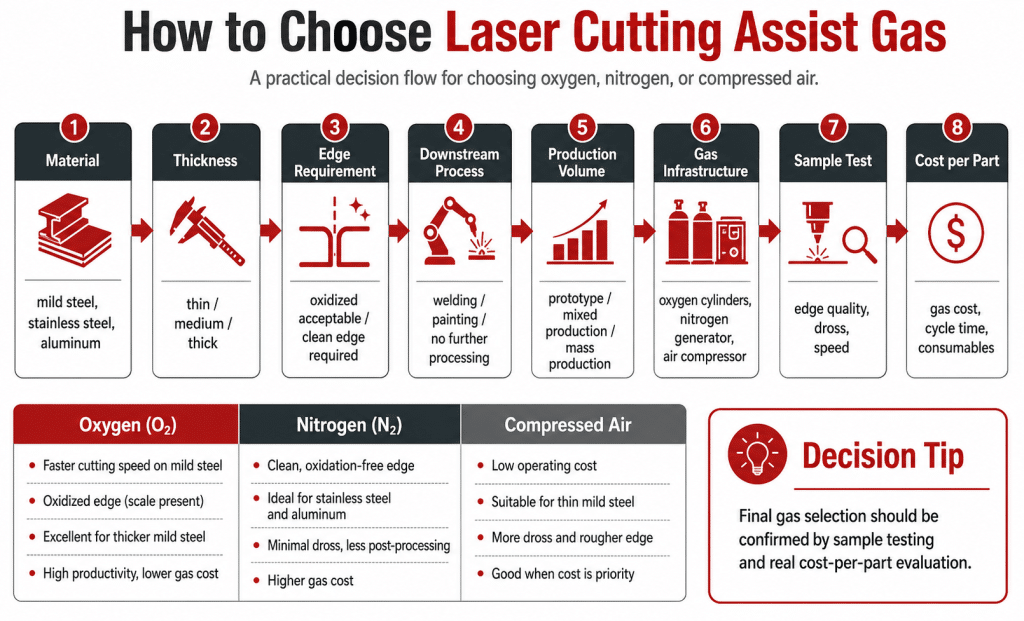
16. How to Select Assist Gas for a New Project
Use the following sequence.
Step 1 — Identify the Material
Specify the actual grade, not only:
steel / stainless / aluminum.
Step 2 — Define Thickness
Record:
- Minimum thickness
- Typical thickness
- Maximum thickness
Step 3 — Define Edge Requirements
Ask:
- Is oxidation acceptable?
- Is visible discoloration acceptable?
- Is dross acceptable?
- Is secondary grinding allowed?
Step 4 — Define the Next Manufacturing Process
Will the component be:
- Welded?
- Painted?
- Powder coated?
- Galvanized?
- Bonded?
- Polished?
Step 5 — Define Production Volume
A process suitable for 20 parts per week may not be economical for thousands of parts per shift.
Step 6 — Evaluate Gas Infrastructure
Check:
- Local gas price
- Delivery
- Storage
- Compressor
- Pipeline
- Generator options
Step 7 — Conduct Sample Cutting
Compare representative samples using suitable gas options.
Record:
- Cutting speed
- Piercing time
- Gas consumption
- Edge condition
- Dross
- Secondary processing
- Total cycle time
Step 8 — Compare Finished-Part Cost
Do not select according to gas price alone.
17. Assist Gas and High-Power Fiber Laser Cutting
As fiber-laser power increases, assist-gas planning becomes more important rather than less important.
High cutting speeds can create high gas demand.
The factory must therefore evaluate:
- Supply capacity
- Pipeline diameter
- Pressure stability
- Peak flow
- Nitrogen storage
- Compressor capacity
- Generator capacity
- Gas cost per shift
Bystronic specifically points out that high-power fiber lasers can substantially increase nitrogen requirements, making gas infrastructure and on-site generation part of the equipment-planning discussion.
This means a high-power laser quotation should not be reviewed in isolation.
The project should consider:
Laser + Cutting Head + Gas Supply + Extraction + Material Handling + Automation
as one complete production system.
18. Questions to Ask Before Choosing a Gas System
Before ordering a machine, ask the supplier:
- Which assist gases are supported?
- Which gas is recommended for our typical material?
- What edge quality should we expect?
- What gas purity is required?
- What operating pressure is required?
- What is the maximum gas flow?
- What nozzle is used?
- What gas consumption can be expected?
- Can compressed air be used?
- What compressor specification is required?
- Can an on-site nitrogen generator be used?
- What nitrogen purity is required?
- Can the system support gas mixtures?
- What pipeline size is required?
- Can our actual materials be tested?
- How does gas selection affect cycle time?
- How does it affect downstream coating?
- What is the expected cost per part?
If the supplier provides only:
“Use oxygen for steel and nitrogen for stainless.”
that is not enough for a serious production evaluation.
19. Final Comparison
| Requirement | Starting Point |
|---|---|
| Carbon steel where oxidation is acceptable | Oxygen |
| Carbon steel requiring cleaner edge | Evaluate nitrogen |
| Stainless requiring low oxidation | Nitrogen |
| Aluminum requiring clean edge | Nitrogen |
| Cost-sensitive suitable thin/medium sheet | Evaluate compressed air |
| High nitrogen consumption | Evaluate bulk supply or nitrogen generation |
| High-power specialized process | Evaluate validated gas mix where supported |
| Titanium / reactive alloy | Evaluate inert-gas process with application engineer |
The table is a starting direction, not a universal parameter chart.
Final gas selection should always be confirmed using:
- Actual material
- Actual thickness
- Actual machine
- Actual downstream requirement
Conclusion
Assist gas is not simply a consumable added after the laser machine has been selected.
It is part of the cutting process.
Oxygen, nitrogen and compressed air create different balances between:
- Cutting performance
- Edge oxidation
- Gas consumption
- Operating cost
- Downstream processing
Oxygen remains valuable for reactive cutting of suitable steels.
Nitrogen is widely used when a low-oxidation edge is required.
Compressed air can provide an economical alternative in compatible applications when the factory can supply sufficiently clean, dry and stable high-pressure air.
High-power fiber lasers have also expanded the use of nitrogen generation and controlled gas mixtures on compatible equipment.
The correct decision should therefore be based on cost per acceptable finished part, not simply gas price or maximum cutting speed.
Test the Right Cutting Process for Your Material
ZG Laser can evaluate your material, thickness, cutting requirements and production volume before recommending a laser cutting configuration.
Send us:
- Material grade
- Thickness
- Part drawing
- Required edge quality
- Production volume
- Downstream process
- Available gas supply
We can evaluate suitable cutting parameters and equipment configuration based on your project requirements.
Send Your Drawing for Evaluation
Explore Laser Cutting Machines
How to Choose a Fiber Laser Cutting Machine
Frequently Asked Questions
What is the purpose of assist gas in laser cutting?
Assist gas helps remove molten material from the kerf and influences oxidation, edge quality and process stability. Depending on the gas, it may also participate chemically in the cutting process.
Is oxygen or nitrogen better for laser cutting?
Neither is universally better. Oxygen can support reactive cutting of carbon steel, while nitrogen is commonly selected when a low-oxidation edge is required.
Why is nitrogen used for stainless steel laser cutting?
Nitrogen is relatively inert in the fusion-cutting process and helps reduce oxidation of the cutting edge.
Can compressed air be used for fiber laser cutting?
Yes, on compatible machines and suitable materials. However, pressure, flow, moisture and oil control must satisfy the machine and process requirements. Compressed-air capability should be verified with the specific laser system.
Is compressed air cheaper than nitrogen?
It can be, but compressed air is not free. Electricity, compressor investment, filtration, drying and maintenance should all be included in the cost calculation.
Does oxygen laser cutting cause oxidation?
Yes. Oxygen actively participates in the cutting reaction and normally creates an oxidized edge.
Can nitrogen be used for carbon steel?
Yes, where the machine and process support it. It may be considered when a cleaner, low-oxidation edge is required.
Can I produce nitrogen at my own factory?
On-site nitrogen-generation systems are available. They extract nitrogen from compressed atmospheric air and can be evaluated for facilities with sufficient continuous nitrogen demand.
What affects laser cutting gas consumption?
Key factors include nozzle design, nozzle diameter, gas pressure, cutting time, material thickness, process type and machine utilization.
Should assist gas be tested before buying a laser machine?
For important production projects, yes. Comparing actual material samples helps determine cutting quality, cycle time, downstream preparation and total cost.