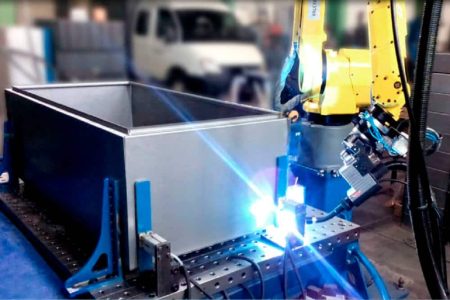
Laser cutting and plasma cutting are two of the most widely used thermal cutting technologies in metal fabrication.
Both can process carbon steel, stainless steel and aluminum. Both can be integrated with CNC tables, automatic nesting, material handling and production software. And both can achieve high productivity when the equipment is matched correctly to the application.
However, they do not solve exactly the same manufacturing problems.
A fiber laser cutting machine is often selected when manufacturers require:
- Fine contours
- Small holes
- Narrow kerf
- High dimensional consistency
- Thin-to-medium sheet productivity
- Flexible automated sheet processing
- Reduced secondary finishing
Plasma cutting is often considered when manufacturers prioritize:
- Thick plate processing
- Lower initial equipment investment
- High cutting speed on thicker metals
- Bevel cutting
- Rugged production environments
- Greater tolerance of imperfect plate surfaces
The correct choice depends on much more than material thickness.
This guide compares laser and plasma cutting in terms of process principle, materials, thickness, speed, precision, edge quality, holes, bevels, operating cost, maintenance and total cost per finished part.
1. Laser Cutting vs Plasma Cutting: Quick Comparison
Before examining each factor in detail, the following table provides a practical starting point.
| Factor | Fiber Laser Cutting | Plasma Cutting |
|---|---|---|
| Cutting method | Focused laser beam | Electrically generated plasma arc |
| Materials | Wide range of metals; other laser types can also process non-metals | Electrically conductive materials |
| Thin sheet | Strong advantage | Suitable, but often less attractive for fine work |
| Thick plate | Capability depends heavily on laser power | Strong application area |
| Fine contours | Excellent | Good, but wider cutting process |
| Small holes | Strong capability with correct process | Modern high-definition plasma can produce good holes |
| Kerf | Generally narrower | Generally wider |
| Dimensional precision | Generally higher | Good for many fabrication requirements |
| Bevel cutting | Available with suitable systems | Established capability |
| Surface condition | Requires controlled process conditions | Often relatively tolerant of imperfect plate |
| Initial investment | Usually higher | Usually lower |
| Automation | Highly developed | Highly developed |
| Best use | Precision sheet-metal production | Heavy plate fabrication |
This table should not be treated as an absolute rule.
Machine power, plasma system class, material, thickness, gas, motion platform and required quality can significantly change the result.
2. How Does Laser Cutting Work?
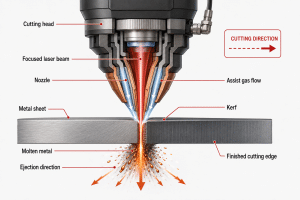
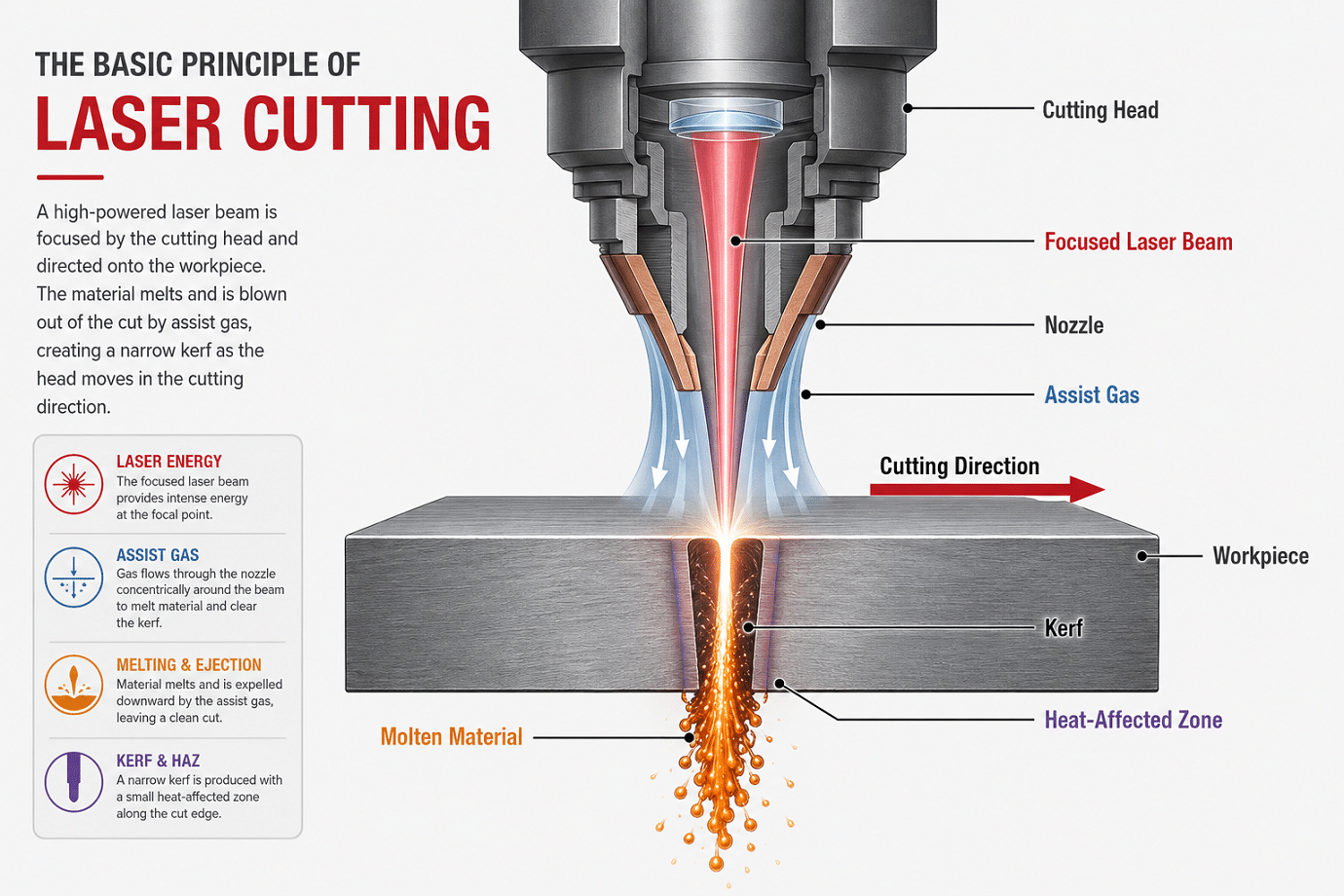
Laser cutting uses a focused beam of light to concentrate energy on a small area of the workpiece.
The material is heated until it:
- Melts
- Burns
- Vaporizes
An assist gas such as oxygen, nitrogen or compressed air then helps remove molten material from the cutting kerf.
The machine coordinates:
- Laser output
- X/Y motion
- Cutting-head height
- Focus position
- Assist-gas pressure
- Piercing
- Cutting speed
Because the focused beam can be very narrow, laser cutting can produce detailed contours and small features.
Industrial fiber lasers are particularly common for sheet-metal cutting because the process can be integrated with:
- CNC nesting
- Automatic loading
- Exchange tables
- Sorting
- Storage systems
- Production monitoring
3. How Does Plasma Cutting Work?
Plasma cutting uses an electrically conductive plasma arc rather than a focused beam of light.
Gas is forced through a narrow torch nozzle while electrical energy ionizes the gas and forms a high-energy plasma arc.
The arc transfers energy into the workpiece, melting the metal. The high-velocity gas stream then removes the molten material from the cut.
A mechanized plasma system usually includes:
- Plasma power supply
- Torch
- Gas system
- CNC cutting table
- Height control
- Motion system
- Fume extraction or water table
- Nesting software
Because the electrical arc must transfer through the workpiece, plasma cutting is used on electrically conductive materials.
Typical materials include:
- Carbon steel
- Stainless steel
- Aluminum
- Other conductive metals
4. Which Materials Can Laser and Plasma Cut?
For conventional metal fabrication, both processes cover many of the same materials.
Carbon Steel
Both laser and plasma can process carbon steel efficiently.
The better process depends on:
- Thickness
- Hole requirements
- Edge quality
- Production speed
- Plate condition
- Downstream operations
Stainless Steel
Both processes are available.
Fiber laser is frequently selected when manufacturers require:
- Fine details
- Narrow kerf
- Low-oxidation nitrogen cutting
- High-quality sheet-metal components
Plasma can remain attractive for thicker stainless components where very fine geometry is not the primary requirement.
Aluminum
Both technologies can process aluminum with appropriate systems.
The decision should consider:
- Alloy
- Thickness
- Surface condition
- Cut quality
- Required tolerance
- Gas cost
Copper and Brass
Compatible modern fiber-laser systems can process reflective metals such as copper and brass.
Plasma can also process electrically conductive non-ferrous metals, although part quality and economics should be tested for the specific application.
Non-Metal Materials
This is an important difference.
Plasma requires an electrically conductive workpiece.
Laser technology, depending on wavelength and system design, can also process materials such as:
- Acrylic
- Wood
- Textiles
- Paper
- Selected polymers
- Glass and ceramics using specialized lasers
A standard industrial fiber laser designed for sheet metal should not be confused with a CO₂ or ultrafast laser used for these non-metal applications.
5. Which Process Is Better for Thin Sheet Metal?
For thin precision sheet-metal applications, fiber laser is generally the stronger starting point.
Typical examples include:
- Electrical cabinets
- Enclosures
- HVAC components
- Kitchen equipment
- Stainless-steel products
- Machinery covers
- Small brackets
- Precision sheet-metal components
Fiber laser offers a small focused spot and narrow kerf, which supports:
- Fine contours
- Closely nested parts
- Small holes
- Tight corners
- High cutting speeds
- Detailed geometry
Thin sheets also reduce the amount of material that the laser must penetrate, allowing modern fiber systems to achieve very high productivity.
For these applications, the machine’s acceleration, piercing time, nesting and loading system may become as important as nominal laser power.
6. Which Process Is Better for Thick Plate?
This is where the comparison becomes more application-dependent.
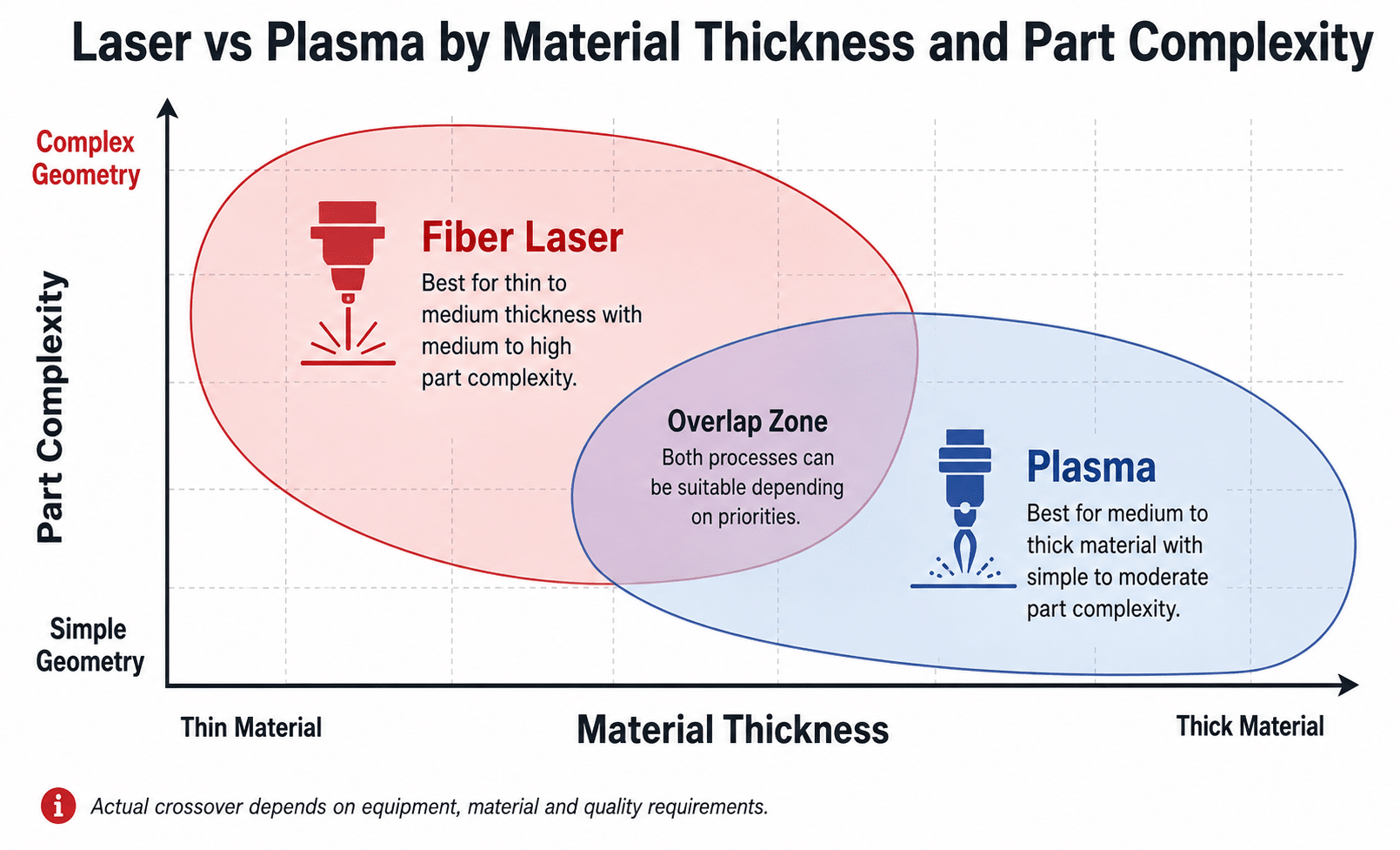
Modern high-power fiber lasers continue to expand into thicker plate, but plasma remains highly competitive in heavy fabrication.
Hypertherm uses approximately 16 mm / 5⁄8 in as a practical crossover region in its comparison, noting that plasma often provides advantages above this range in cutting speed and economics.
This should be treated as a rule of thumb rather than a universal boundary.
The crossover point depends on:
- Fiber-laser power
- Plasma current
- Material
- Assist gas
- Edge-quality requirements
- Piercing
- Hole quantity
- Machine utilization
- Electricity and gas costs
- Secondary processing
For example, a manufacturer cutting 20 mm plate with hundreds of small precision features may make a different decision from a structural fabricator cutting large simple contours from the same thickness.
Heavy Fabrication Applications
Plasma may deserve serious consideration for:
- Heavy machinery
- Structural fabrication
- Shipbuilding
- Large welded structures
- Mining equipment
- Heavy equipment
- Thick steel plate
Precision Thick-Plate Production
Laser may still be selected when the production value comes from:
- Detailed geometry
- Tight part spacing
- Small features
- Reduced finishing
- Automated high-mix production
- Integration with existing laser automation
Do not choose solely from a thickness chart.
7. Which Process Cuts Faster?
There is no single answer.
Cutting speed changes significantly with material thickness.
Thin Sheet
Fiber laser can achieve extremely high linear cutting speeds on suitable thin materials.
However, real productivity must include:
- Piercing
- Corner movement
- Acceleration
- Sheet loading
- Table exchange
- Part unloading
- Sorting
Thick Plate
Modern plasma systems can be extremely productive in thicker material.
A plasma system may become faster than fiber laser once plate thickness enters the range where the laser requires significantly more energy and slower piercing or cutting strategies.
Do Not Compare Only Straight-Line Speed
A manufacturer’s specification may list:
Maximum cutting speed: XX m/min
That does not tell you how many finished parts the system produces per shift.
Compare:
Complete Cycle Time = Loading + Piercing + Cutting + Repositioning + Unloading
For high-mix sheet-metal production, automation can change the result dramatically.
8. Which Process Is More Precise?
Laser generally offers the stronger precision capability because the focused beam and kerf are relatively small.
This is especially useful for:
- Fine contours
- Narrow slots
- Small features
- Closely spaced geometry
- High-density nesting
TRUMPF’s technology comparison describes laser cutting as having a very fine cutting beam capable of detailed contours, while plasma uses a broader cutting process.
However, modern high-definition plasma is substantially more capable than older plasma systems.
For many heavy fabrication applications, plasma accuracy can fully satisfy the drawing requirements.
Do You Actually Need Laser-Level Precision?
This is an important purchasing question.
If a part specification allows a relatively generous tolerance and will later be:
- Welded
- Machined
- Ground
- Assembled into a large structure
paying for higher cutting precision may not create additional value.
The correct tolerance is:
The tolerance required by the finished product
—not the smallest tolerance a machine can theoretically achieve.
9. Kerf Width and Material Utilization
The kerf is the width of material removed during cutting.
Laser generally produces a narrower kerf than plasma.
A narrower kerf can help when:
- Parts are tightly nested
- Features are small
- Material is expensive
- Sheet utilization is important
- Narrow slots are required
However, kerf alone does not determine material yield.
Actual utilization also depends on:
- Nesting software
- Part spacing
- Common-line cutting
- Sheet dimensions
- Scrap strategy
- Heat distribution
- Part stability
For large heavy-plate parts with simple shapes, the economic value of a very narrow kerf may be relatively small.
10. Which Process Produces Better Small Holes?
Small-hole capability is an important reason many manufacturers choose laser.
Laser can be particularly effective for:
- Small circular holes
- Fine ventilation patterns
- Mounting holes
- Dense feature layouts
- Thin-sheet perforations
Modern high-definition plasma systems have greatly improved hole quality and can produce good bolt-ready holes in suitable thicknesses and hole sizes.
However, very small diameter-to-thickness ratios remain more demanding for plasma.
Evaluate the Actual Drawing
If your parts contain:
- Many small holes
- Closely spaced holes
- Small slots
- Fine corners
send the real CAD file to both suppliers.
Do not compare only a large outside contour.
11. What About Bevel Cutting?
Plasma has long been used for bevel preparation in heavy fabrication.
Typical bevel applications include:
- V bevels
- Y bevels
- K bevels
- Weld preparation
- Structural components
- Shipbuilding plates
Modern bevel plasma heads are particularly relevant when components will proceed directly to heavy welding.
Laser bevel cutting is also available with suitable multi-axis or bevel cutting heads.
Laser may provide advantages where bevel geometry must be combined with:
- Smaller features
- Detailed contours
- Higher precision
- Flexible programmed geometry
The Key Question
Do not ask only:
Can the machine bevel?
Ask:
- What bevel angle range is supported?
- What thickness?
- What edge quality?
- What cycle time?
- How is the torch/head calibrated?
- How is bevel compensation handled?
- How consistent is the root face?
- What secondary preparation is required?
12. Which Produces Better Edge Quality?
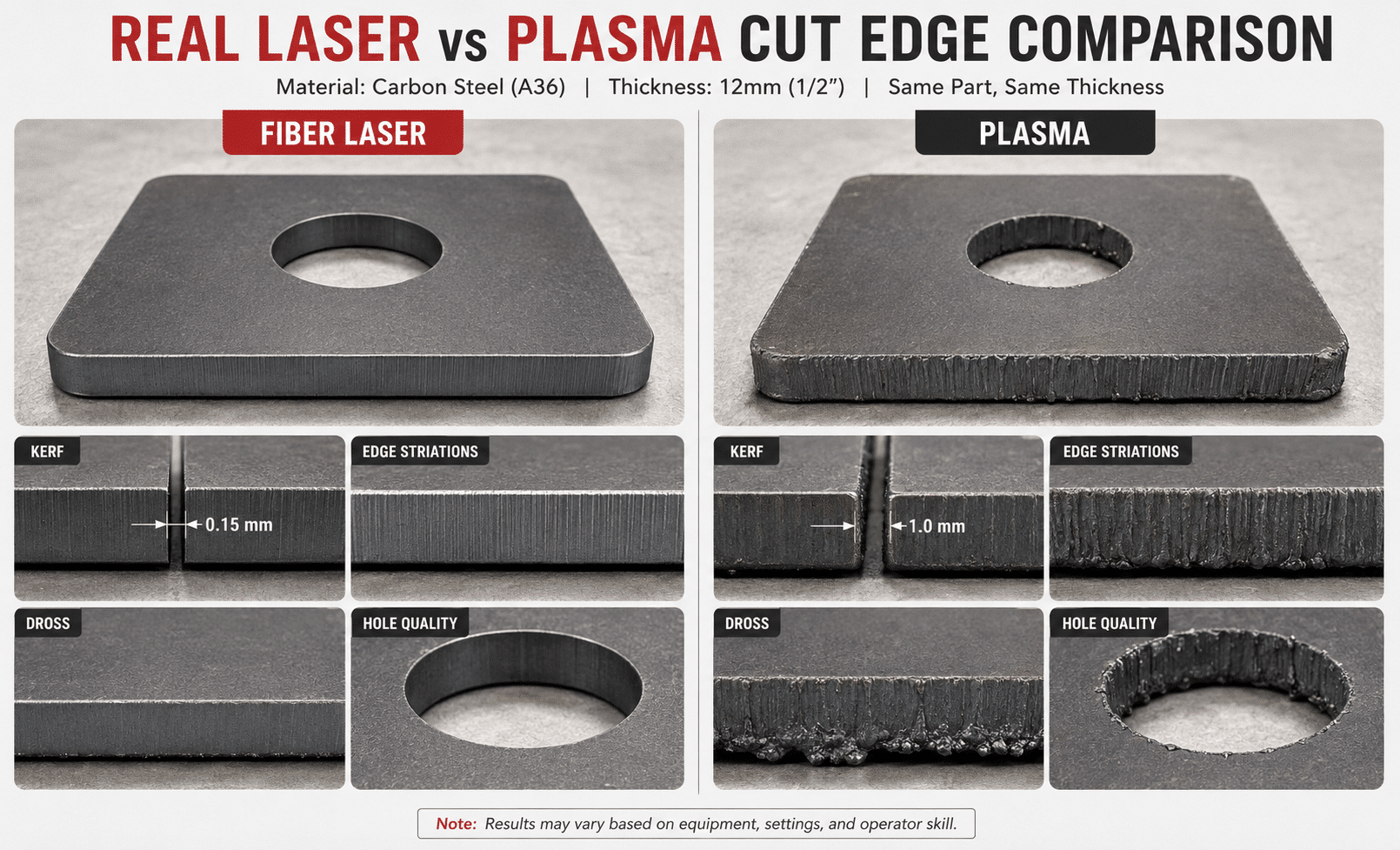
This depends strongly on thickness and equipment class.
Laser Edge Quality
Laser cutting can provide:
- Narrow kerf
- Fine contour definition
- Relatively low dross under optimized conditions
- Clean nitrogen-cut edges
- Reduced secondary finishing
But poor parameters can still create:
- Dross
- Striations
- Oxidation
- Roughness
- Taper
Plasma Edge Quality
Modern high-definition plasma can produce high-quality edges that are dramatically better than conventional older plasma cutting.
For thick plate, some high-definition plasma processes can produce very smooth cut surfaces.
Therefore, a blanket statement such as:
“Laser always produces a better edge.”
is not technically reliable.
The correct comparison requires:
- Same material
- Same thickness
- Same drawing
- Same quality criteria
- Comparable machine condition
13. Heat-Affected Zone and Part Distortion
Both processes are thermal cutting methods.
Both can create:
- Heat-affected zones
- Thermal stress
- Oxidation
- Distortion
The degree depends on:
- Power
- Cutting speed
- Material
- Thickness
- Cutting sequence
- Part geometry
Because laser concentrates energy into a relatively small cutting area, it can provide a relatively narrow heat-affected region in many precision-sheet applications.
Plasma uses a broader high-energy arc, and heat management may become more important for:
- Thin parts
- Narrow sections
- Long contours
However, heat distortion should be evaluated on the actual part rather than assumed from the cutting technology alone.
14. How Does Plate Surface Condition Affect the Process?
Real production material is not always perfectly clean.
Plate may contain:
- Rust
- Mill scale
- Paint
- Oil
- Scratches
- Surface variation
- Warping
Plasma is generally regarded as relatively forgiving when processing imperfect conductive metal surfaces.
Laser cutting may require more controlled surface and parameter conditions, particularly when:
- Piercing thick material
- Cutting reflective materials
- Maintaining high edge quality
This does not mean laser requires perfectly polished material.
It means the supplier should test the material condition actually used in your factory.
15. Initial Investment: Laser vs Plasma
Plasma generally has a lower equipment-entry cost than a comparable industrial fiber-laser cutting system.
A mechanized plasma installation may require:
- CNC table
- Plasma power source
- Torch
- Height control
- Fume extraction
- Software
A fiber-laser system may include:
- Laser source
- Precision cutting head
- Enclosed machine structure
- Chiller
- CNC
- Assist-gas system
- Dust extraction
- Exchange tables
- Safety systems
Automation can increase the investment in either process.
Why Initial Price Is Not Enough
A lower machine price does not automatically mean lower production cost.
Evaluate:
- Productivity
- Labor
- Consumables
- Electricity
- Gas
- Secondary finishing
- Scrap
- Maintenance
- Downtime
- Machine utilization
A more expensive machine can be justified if the production economics support it.
Likewise, buying a high-power fiber laser for work that plasma can complete economically may create unnecessary capital cost.
How to evaluate the total cost of an industrial laser cutting machine
16. Operating Costs
Operating cost should be calculated per acceptable part rather than per machine hour alone.
Fiber Laser Costs May Include
- Electricity
- Oxygen
- Nitrogen
- Compressed air
- Protective lenses
- Nozzles
- Ceramic rings
- Filters
- Chiller maintenance
- Cutting-head maintenance
- Laser-source service
Plasma Costs May Include
- Electricity
- Plasma gas
- Shield gas
- Electrodes
- Nozzles
- Swirl rings
- Shields
- Torch parts
- Extraction
- Cooling-system maintenance
Secondary Processing Cost
This is frequently forgotten.
If one process requires more:
- Grinding
- Deburring
- Edge cleaning
- Hole rework
- Oxide removal
- Machining
those costs belong in the cutting comparison.
The better metric is:
Cost per Acceptable Finished Part
not:
Cost per Cutting Hour
17. Consumables and Maintenance
The two systems have different maintenance profiles.
Laser
Important items include:
- Protective windows
- Cutting nozzles
- Ceramic components
- Dust extraction filters
- Cooling system
- Motion system
- Optical cleanliness
Modern fiber-laser sources have relatively few moving optical components, but cutting-head contamination or damage can still be expensive.
Plasma
The plasma arc operates through replaceable torch consumables.
Common consumables include:
- Electrode
- Nozzle
- Shield
- Swirl ring
Consumable life depends on:
- Number of starts
- Current
- Material
- Thickness
- Piercing method
- Gas
- Operator practice
A professional comparison should use real consumable-life data from the expected application.
18. Automation and Unattended Production
Both processes can be automated.
Fiber Laser Automation
Possible systems include:
- Automatic sheet loading
- Automatic unloading
- Storage towers
- Sheet inventory
- Part sorting
- Automatic nozzle changing
- Production scheduling
- Remote monitoring
Laser is particularly well suited to high-mix digital sheet-metal production because CAD files can be nested and scheduled without changing physical tooling.
Plasma Automation
Mechanized plasma can integrate:
- Plate handling
- CNC nesting
- Bevel cutting
- Marking
- Drilling in combination systems
- Material tracking
For very large or thick plates, plasma tables can also offer large working areas without requiring the same fully enclosed machine architecture as many high-power laser systems.
19. Factory Space and Infrastructure
Do not compare machines only by the cutting table dimensions.
Laser Installation May Require
- Machine enclosure
- Laser source
- Chiller
- Dust collector
- Gas supply
- Nitrogen system
- Compressor
- Transformer
- Loading/unloading space
- Automation tower
Plasma Installation May Require
- Cutting table
- Plasma power source
- Gas system
- Downdraft extraction or water table
- Plate loading area
- Scrap removal
- Bevel clearance
For very large heavy plate, factory crane capacity and material logistics may dominate the layout decision.
20. Safety and Fume Extraction
Both technologies require professional industrial safety systems.
Laser Safety
Risks may include:
- Laser radiation
- Reflected radiation
- Fumes
- Hot material
- Fire
- Compressed gases
- Electrical equipment
Industrial high-power laser machines commonly use protective enclosures, interlocks and controlled observation windows.
Plasma Safety
Risks may include:
- Electrical arc
- UV radiation
- Hot metal
- Sparks
- Fumes
- Noise
- Compressed gases
Mechanized systems commonly use downdraft extraction or water tables to manage cutting fumes.
Neither process should be selected without considering the factory’s ventilation and safety requirements.
21. Laser vs Plasma for Different Industries
Sheet Metal Fabrication
Usually evaluate laser first when:
- Sheet is thin or medium thickness
- Part variety is high
- Small features are common
- Precision matters
- Automation is planned
Heavy Machinery
Plasma deserves strong consideration when:
- Plate is thick
- Components are large
- Geometry is relatively simple
- Welding follows cutting
Laser may still be appropriate when finer features or higher precision justify it.
Structural Steel
Depending on the workpiece, manufacturers may use:
- Plasma plate cutting
- Laser plate cutting
- Dedicated beam laser cutting
- Drilling and sawing systems
The correct system depends on whether the raw material is plate, H-beam, I-beam or profile.
Shipbuilding
Plasma has traditionally been strong for:
- Large thick plates
- Bevels
- Weld preparation
High-power laser technology continues to expand into heavy plate applications, but economics and working-area requirements must be evaluated carefully.
Stainless Fabrication
Laser is attractive for:
- Fine contours
- Clean nitrogen-cut edges
- Decorative products
- Food-processing equipment
- Kitchen equipment
Agricultural and Construction Equipment
Factories often have a broad thickness range.
The correct solution may be:
- Laser
- Plasma
- Both
A high-volume manufacturer may operate laser for thin precision components and plasma for large thick components.
22. Do You Need Both Laser and Plasma?
For some factories, this is the correct answer.
Instead of forcing every part through one technology, production can be divided according to manufacturing requirements.
Example Production Strategy
Fiber Laser
- 1–12 mm high-mix sheet parts
- Small holes
- Detailed components
- Enclosures
- Precision brackets
Plasma
- Heavy plate
- Large weldments
- Thick structural components
- Bevel preparation
The numbers above are only an example workflow—not universal thickness limits.
The real crossover should be calculated using the factory’s own:
- Machines
- Materials
- Drawings
- Labor cost
- Gas cost
- Required quality
23. How to Choose Between Laser and Plasma
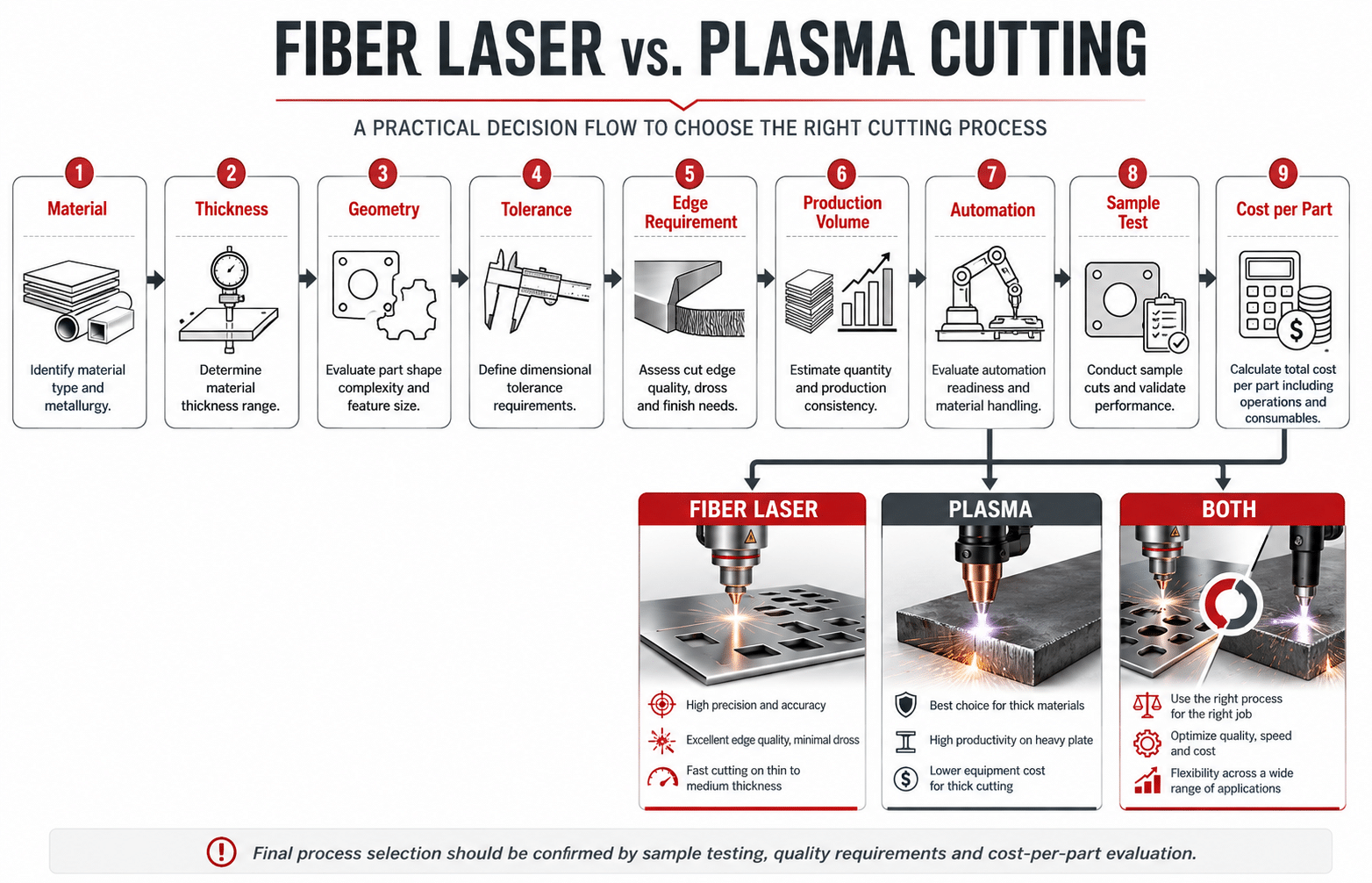
Use the following sequence.
Step 1 — List Your Materials
Record:
- Carbon steel
- Stainless steel
- Aluminum
- Other metals
Step 2 — Build a Thickness Distribution
Do not provide only your maximum thickness.
For example:
| Thickness Range | Share of Production |
|---|---|
| Thin | 50% |
| Medium | 35% |
| Thick | 15% |
The process should be optimized for the majority of production.
Step 3 — Review Part Geometry
Identify:
- Small holes
- Slots
- Fine contours
- Large simple profiles
- Bevels
- Weld-preparation features
Step 4 — Define Tolerance
Ask:
What does the drawing actually require?
Do not pay for unnecessary precision.
Step 5 — Define Edge Requirements
Consider:
- Dross
- Oxidation
- Roughness
- Bevel
- Secondary grinding
Step 6 — Define Production Volume
Calculate:
- Parts per shift
- Plates per day
- Number of shifts
- Batch size
Step 7 — Evaluate Automation
Determine whether you need:
- Automatic loading
- Automatic unloading
- Unattended production
- Material storage
- Sorting
Step 8 — Compare Total Cost
Include:
- Machine
- Installation
- Electricity
- Gas
- Consumables
- Labor
- Maintenance
- Scrap
- Secondary processing
- Downtime
Step 9 — Conduct Real Sample Testing
Provide both suppliers with:
- Same drawing
- Same material
- Same thickness
- Same quality specification
Then compare actual results.
24. What Should Be Compared During a Cutting Test?
Do not judge samples only by appearance.
Record:
Quality
- Dimensional accuracy
- Hole diameter
- Hole position
- Edge roughness
- Dross
- Taper
- Heat distortion
Productivity
- Piercing time
- Actual cutting time
- Complete cycle time
- Part removal time
Operating Cost
- Electricity
- Gas
- Consumables
- Secondary processing
Stability
Cut multiple identical parts.
Compare:
- First part
- Middle parts
- Last part
- Consumable condition
- Alarm frequency
A single perfect demonstration sample is not a production validation.
25. Laser vs Plasma Selection Matrix
| Production Requirement | Strong Starting Direction |
|---|---|
| Thin precision sheet | Fiber laser |
| Fine contours | Fiber laser |
| Many small holes | Fiber laser |
| High-mix sheet production | Fiber laser |
| Narrow kerf required | Fiber laser |
| Automated sheet factory | Fiber laser |
| Thick heavy plate | Evaluate plasma strongly |
| Large simple profiles | Plasma may be more economical |
| Extensive bevel welding preparation | Plasma is a strong candidate |
| Rough or imperfect plate | Plasma deserves evaluation |
| Mixed thin and thick production | Compare both or use both |
| Highest flexibility across very different parts | Evaluate complete factory mix |
This is a decision guide rather than a fixed technical specification table.
26. When Does a Fiber Laser Make More Sense?
A fiber laser is usually worth serious consideration when most of the following are true:
- Most production is thin-to-medium sheet
- Fine features are important
- Parts contain many small holes
- Material utilization matters
- Production is high-mix
- Fast program changes are required
- Automation is valuable
- Secondary finishing should be minimized
- Floor-to-floor production flow is important
How to choose a fiber laser cutting machine
27. When Does Plasma Make More Sense?
Plasma should be evaluated seriously when:
- Thick plate represents a major share of production
- Part geometry is relatively large
- Required tolerances do not justify laser precision
- Bevel cutting is important
- Initial investment must be controlled
- Plate surfaces are imperfect
- Heavy welding follows cutting
- Large working areas are required
Modern high-definition plasma should not be evaluated using expectations based on older conventional plasma systems.
Its capability in holes, edge quality and beveling has improved significantly.
28. Why the Cheapest Machine May Be the Wrong Choice
Consider two hypothetical factories.
Factory A
Produces:
- 2–6 mm stainless steel
- Hundreds of different SKUs
- Small holes
- Decorative surfaces
- Small batches
A lower-cost plasma table might not produce the lowest finished-part cost if it creates additional finishing and cannot match required feature detail.
Factory B
Produces:
- Large heavy carbon-steel plates
- Simple profiles
- Welded machinery structures
- Relatively generous tolerances
A high-power laser might be technically capable but financially unnecessary if plasma already meets every requirement at a lower total cost.
Technology should follow the part—not marketing.
29. Questions to Ask Before Buying Either System
Ask the supplier:
- Can you cut our actual material?
- What thickness range is optimized?
- What is production speed on our typical thickness?
- What tolerance can be demonstrated?
- Can our smallest holes be produced?
- What edge quality should we expect?
- How much dross is typical?
- Is bevel cutting required?
- What consumables are required?
- What is the expected consumable life?
- What gas system is required?
- What electricity supply is required?
- What extraction system is required?
- What secondary finishing will remain?
- What automation is available?
- What is the complete machine footprint?
- What maintenance is required?
- What local service is available?
- Can you run a repeated-part test?
- What is the estimated cost per finished part?
30. Final Selection Checklist
Before deciding between a laser cutting machine and plasma cutting system, confirm:
- Material types
- Thickness distribution
- Largest plate size
- Typical part geometry
- Smallest features
- Hole requirements
- Tolerance
- Edge requirements
- Bevel requirements
- Plate surface condition
- Production volume
- Batch size
- Automation requirements
- Labor cost
- Gas cost
- Electricity cost
- Secondary finishing
- Factory space
- Service requirements
- Sample cutting results
- Total cost per finished part
Conclusion
Laser cutting and plasma cutting are both highly capable industrial metal-cutting processes.
Fiber laser is particularly strong when manufacturers need:
- Fine geometry
- Small features
- Narrow kerf
- Precision
- High productivity on suitable sheet thicknesses
- Digital automation
Plasma remains highly competitive when manufacturers need:
- Thick-plate productivity
- Large working areas
- Bevel cutting
- Lower capital investment
- Robust heavy-fabrication capability
The crossover is not defined by one thickness number.
It depends on the complete production requirement.
A manufacturer cutting precision stainless enclosures has very different priorities from a company producing heavy welded machinery frames.
The safest approach is to compare both processes using your actual drawing, material, thickness, tolerance and production volume.
Then calculate:
Cost per acceptable finished part.
That is more useful than asking whether laser or plasma is universally “better.”
Discuss Your Metal Cutting Project With ZG Laser
If fiber laser appears suitable for your application, ZG Laser can evaluate your:
- Material
- Thickness range
- Drawing
- Required tolerance
- Edge quality
- Production volume
- Target cycle time
- Automation requirements
Our application team can recommend an appropriate laser power, working area and machine configuration based on your actual production needs.
View High-Power Fiber Laser Cutting Machine
Frequently Asked Questions
Is laser cutting better than plasma cutting?
Not in every application. Fiber laser is generally stronger for fine features, narrow kerf and precision sheet-metal production, while plasma can be highly competitive for thick plate, bevel cutting and heavy fabrication.
Is plasma cheaper than laser cutting?
Plasma equipment generally has a lower initial investment, but the correct comparison should include productivity, consumables, labor, secondary finishing and total cost per finished part.
Which is more accurate, laser or plasma?
Laser generally provides higher dimensional precision and a narrower kerf. Modern high-definition plasma can still meet many fabrication tolerances, particularly where extreme precision is unnecessary.
Which is faster, plasma or laser?
It depends on thickness. Fiber laser can be extremely fast on thin sheet, while plasma can become highly competitive or faster as material thickness increases.
Is plasma better for thick steel?
Plasma is a strong option for thick carbon-steel plate, particularly when production speed, bevel capability and capital cost are priorities. High-power fiber laser should still be compared where fine features or automation justify the investment.
Can laser and plasma both cut stainless steel?
Yes. Both can process stainless steel with appropriate systems and gases.
Can laser and plasma cut aluminum?
Yes. Both technologies can process aluminum when correctly configured.
Can plasma cut non-metal materials?
No. Plasma cutting requires an electrically conductive workpiece.
Which process makes smaller holes?
Fiber laser generally has the advantage for very small holes and detailed features because of its narrower cutting beam and kerf.
Which process is better for bevel cutting?
Plasma has a strong history in heavy-plate bevel preparation. Laser bevel cutting is also available and may be attractive where precision and detailed geometry are important.
Should I compare machines using my actual parts?
Yes. The most useful comparison uses the same material, thickness, drawing, tolerance and quality criteria for both processes.