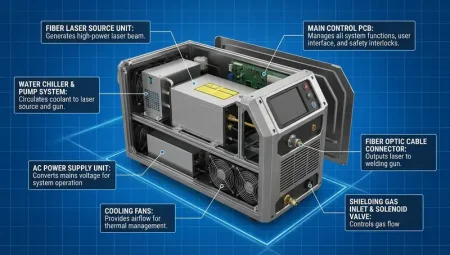
In our previous discussion, we disassembled the handheld gun—the precision tool in your hand. But as any veteran engineer will tell you, the gun is only the tip of the spear. The true heavy lifting happens inside the main cabinet, a powerhouse of optics, thermodynamics, and digital logic.
To the uninitiated, a laser welding machine might look like a simple metal enclosure on caster wheels. But crack open that chassis, and you enter a world of high-stakes engineering. Understanding the internal anatomy of your laser welding system separates the “operators” from the “technicians”. When you grasp how the fiber laser source communicates with the water chiller and the control algorithms, you gain the ability to troubleshoot complex issues, optimize your laser welding parameters, and extend the lifespan of your equipment.
Today, we are going deep under the hood. We will break down the seven structural pillars that power a modern industrial laser welder, expanding on the technical details that drive performance.
1. Fiber Laser Source Unit: The Optical Powerhouse
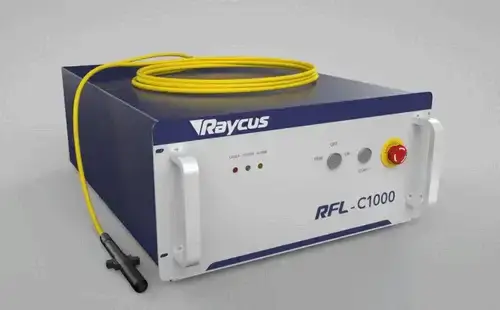
The undisputed heart of the machine is the Fiber Laser Source Unit. Whether you are running a compact 1,500W unit or a heavy-duty 3,000W system, this module is where the photon magic happens.
Unlike older CO2 or YAG technologies that relied on fragile mirrors and frequent alignment, modern fiber laser sources (from brands like IPG, Raycus, MAX, or JPT) utilize a solid-state architecture. Banks of high-efficiency pump diodes generate light, which is then excited and amplified through a rare-earth-doped active fiber (typically Ytterbium).
- Technical Deep Dive:
- Wall-Plug Efficiency:Modern sources boast electro-optical conversion efficiencies exceeding 30-40%. This means less power consumption for the shop and less waste heat to manage compared to older technologies.
- Beam Quality (M² factor):This metric defines how “bright” and focusable the beam is. A lower M² value means the laser can be focused to a tighter spot, providing deeper penetration for the same power—critical for deep penetration welding.
- Modulation Capabilities:The source doesn’t just turn on and off. It can modulate the beam at frequencies up to 50kHz. This allows for sophisticated pulse shaping, enabling you to control heat input precisely when welding thin sheets or heat-sensitive alloys.
Pro Tip: The laser source is hermetically sealed in a cleanroom environment. Never attempt to open this module. Even microscopic dust on the internal splice blocks can cause catastrophic failure of the active fiber.
2. Main Control PCB: The Digital Brain
If the source is the heart, the Main Control PCB (Printed Circuit Board) is the central nervous system. Situated in a shielded electronics bay to protect against electromagnetic interference (EMI), this board is the maestro conducting the entire orchestra.
It is responsible for the synchronous management of the laser, the wobble head motion, gas delivery, and safety protocols. It translates your touchscreen inputs into high-speed electrical signals.
- Advanced Functionality:
- Waveform Control: The PCB manages “Ramp Up” and “Ramp Down” times. By slowly increasing power at the start and tapering it off at the end, it prevents “crater” formation and porosity at the weld stop point—a common defect in manual welding.
- Safety Logic: It constantly monitors the “safety loop.” This includes the continuity of the fiber optic connector, the temperature of the gun, and the contact state of the nozzle. If any sensor reports an anomaly, the PCB executes an emergency stop in milliseconds (Safety Integrity Level standards).
- Proprietary Algorithms: The board stores pre-set laser welding libraries. When you select “Aluminum,” it adjusts the wobble frequency and duty cycle specifically to break the oxide layer and stabilize the molten pool.
3. Water Chiller & Pump System: The Thermal Stabilizer
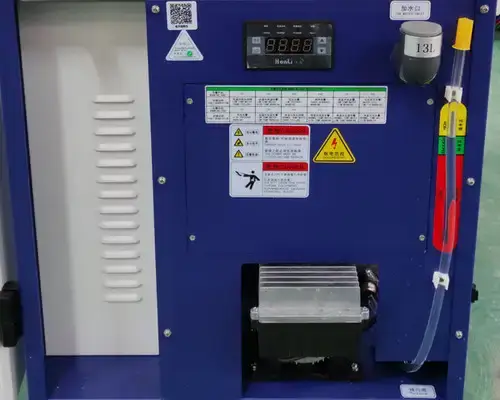
High-power lasers are incredibly energy-dense, and despite their efficiency, they generate significant waste heat. The Water Chiller & Pump System is the life support unit that keeps the machine from melting itself down.
In integrated handheld laser welding machines, this is typically a compressor-based refrigeration cycle built directly into the chassis. It circulates coolant to stabilize the temperature of critical components.
- Dual-Circuit Architecture:
- Low-Temperature Loop (Laser Source): Maintained strictly between 22°C and 25°C. This is critical because the wavelength of the pump diodes can shift with temperature, reducing the efficiency and stability of the laser output.
- High-Temperature Loop (Optics): Circulates to the welding gun (QBH connector and optics) at around 30°C. Keeping this loop warmer prevents condensation (dew) from forming on the protective windows and lenses, which would be disastrous for beam transmission.
- Flow & Level Sensors: The system includes interlocks for water flow and tank level. If a hose kinks or the pump fails, the chiller sends a hard “kill signal” to the Main Control PCB, preventing the laser from firing without cooling.
4. AC Power Supply Unit: The Energy Rectifier
The wall outlet provides raw, alternating current (AC) which is often unstable in industrial environments. The AC Power Supply Unit (PSU) is responsible for converting this into clean, stable direct current (DC) voltages (typically 24V and 48V) required by the control logic, sensors, and internal drivers.
For the high-voltage requirements of the laser source itself, robust 3-phase rectification is often employed in higher power units.
- Critical Roles:
- Voltage Stabilization: Laser welding equipment is sensitive to voltage fluctuations. A dip in the mains power could cause the laser power to sag, resulting in inconsistent weld penetration. The PSU buffers these fluctuations.
- Inrush Current Protection: When the compressor of the water chiller kicks in, it draws a massive spike of current. A high-quality PSU and soft-start circuit ensure this doesn’t trip the shop breakers or starve the sensitive control electronics.
- EMC Filtering: It filters out high-frequency noise from the grid (like nearby CNC machines) and prevents the laser machine from injecting noise back into the grid, ensuring compliance with industrial electrical standards.
5. Cooling Fans: The Airflow Managers
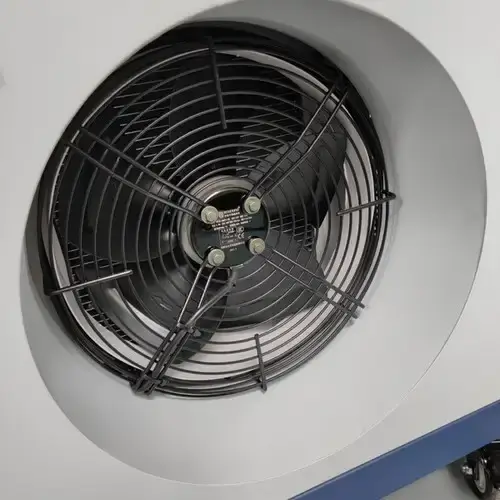
While the water chiller handles the laser source and gun, the massive array of electronics inside the cabinet—including the AC power supply and the chiller’s own condenser—needs to breathe. This is the job of the high-static-pressure Cooling Fans.
These are not standard computer fans; they are industrial-grade air movers designed to maintain a specific thermal envelope within the cabinet.
- Thermal Dynamics:
- Heat Exchange: The chiller removes heat from the water and dumps it into a radiator (condenser). The fans must pull massive amounts of air (high CFM) through this radiator to reject the heat into the room.
- Positive Pressure Strategy: High-end machines often use a positive pressure design. Intake fans push air through fine-mesh dust filters, creating higher pressure inside the cabinet than outside. This forces air out of cracks and crevices, preventing conductive shop dust from settling on the Main Control PCB.
- Variable Speed Control: Modern systems adjust fan speed based on ambient temperature sensors, reducing noise during idle times and ramping up during heavy duty cycles.
6. Fiber Optic Cable Connector: The Precision Interface
Extending from the front or back of the machine is the Fiber Optic Cable Connector (commonly QBH, QCS, or QD standards). This is the physical interface where the laser light leaves the safe confines of the cabinet and enters the delivery cable.
This component is more than just a plug; it is a sophisticated optical coupler that must handle kilowatt-level power densities without overheating.
- Structural Features:
- Quartz Block: The core is a quartz block that expands the beam slightly to reduce energy density at the interface surface, preventing optical damage.
- Interlock Pins: The connector contains gold-plated contact pins that close a safety circuit. If the cable is not fully seated or if the fiber is severed, the circuit opens, and the laser source is instantly disabled.
- Bend Radius Protection: A heavy-duty strain relief boot protects the fiber at the exit point. Fiber cables have a “critical bend radius”—bend them too sharp, and light leaks out of the core into the cladding, burning the cable coating instantly.
7. Shielding Gas Inlet & Solenoid Valve: The Atmosphere Controller
The Shielding Gas Inlet connects your laser welding machine to an external gas cylinder (Argon, Nitrogen, or Helium). But the machine manages the flow intelligently via an internal electronic Solenoid Valve.
This valve is the gatekeeper of weld quality, controlled with millisecond precision by the Main Control PCB.
- Process Control:
- Pre-Flow Timing: The system opens the valve 200–500ms before the laser fires. This purges atmospheric oxygen from the nozzle and establishes a laminar gas shield before the metal melts.
- Post-Flow Timing: After the laser stops, the gas continues to flow for a set duration. This protects the cooling weld pool and the hot tungsten/copper nozzle from oxidation while they return to safe temperatures.
- Cost Efficiency: By automating this cycle, the machine drastically reduces gas consumption compared to manual valves, ensuring expensive Argon is only used when the arc is active.
Finally, you can read my other article about handheld laser welding gun: Inside the Torch: A Deep Dive into the Laser Welding Gun Structure for Handheld Machines
FAQ
Q1: How does the laser source duty cycle affect my production?
A: Most industrial fiber laser sources are rated for Continuous Wave (CW) operation, meaning they can run at 100% power indefinitely, provided the water chiller keeps them cool. However, the limitation is usually the handheld gun’s ability to dissipate heat, not the source unit itself.
Q2: My machine has a “Clean Air” inlet and a “Shielding Gas” inlet. What is the difference?
A: This is a crucial structural distinction.
Shielding Gas Inlet: Used for Argon/Nitrogen to protect the weld pool from oxidation.
Clean Air (CDA) Inlet: Used in some advanced guns to provide “air knife” protection for the optics or to cool the nozzle body. Never mix these up. Putting shop air into the shielding line will inject moisture and oil into your weld, causing immediate porosity defects.
Q3: Why is the water chiller temperature set to two different values?
A: The laser source operates most efficiently at a lower temperature (22-25°C). However, if we ran the welding gun water at that temperature, the humidity in the shop air would condense on the cold nozzle and lenses (sweating). Therefore, the second loop is kept warmer (30°C)—above the ambient dew point—to prevent moisture damage to the optics.
Q4: Can I upgrade the Main Control PCB software?
A: Yes, reputable manufacturers often release firmware updates. These updates can optimize the wobble galvanometer algorithms, add new material libraries, or improve the safety logic. This is done via a USB port typically located on the front panel near the screen.
Q5: What happens if the AC Power Supply phase is unbalanced?
A: If you are running a 3-phase 380V machine, a significant phase imbalance (voltage difference between legs) can cause the internal DC bus voltage to ripple. This stresses the capacitors and can cause the laser source to shut down to protect itself. Always have an electrician verify your shop’s power stability before installation.
Q6: The machine alarms “Laser Source Overheat,” but the chiller water is cold. Why?
A: This indicates a flow issue, not a temperature issue.
Flow Restriction: The laser source has internal cooling plates with narrow channels. If you used tap water, mineral scale might have blocked them.
Kinked Hose: Check inside the cabinet. Sometimes the heavy fiber optic cable shifts and pinches a water line.
Pump Failure: The water might be cold in the tank, but if the pump impeller is damaged, that cold water isn’t reaching the laser source.
Q7: Nitrogen vs. Argon: Which shielding gas should I use?
A: The choice depends entirely on the base material you are welding and your budget. Here is the engineering breakdown:
Argon (The Universal Standard):
Best for:Aluminum, Titanium, Copper, and Carbon Steel.
Why:Argon is a completely inert noble gas. It does not react with the molten metal.
Critical Rule:You must use Argon for Aluminum. If you use Nitrogen on Aluminum, it reacts to form Aluminum Nitride, resulting in a black, brittle weld that will fail.
Nitrogen (The Stainless Specialist):
Best for:Stainless Steel (304/316 series).
Why:Nitrogen is significantly cheaper than Argon. Technically, it helps stabilize the austenitic structure of stainless steel and provides a smoother, “shinier” finish with less heat tint discoloration compared to Argon.
Cost Benefit:For shops doing high-volume stainless work, switching to Nitrogen can reduce gas costs by 30–40%.
Summary: Use Argon for everything to be safe. Switch to Nitrogen only for Stainless Steel if you want to save money and improve the visual finish.
Q8: How do I know if my Fiber Laser Source is losing power?
A: True source degradation is rare before 100,000 hours. If the machine feels “weak”:
99% Probability: It is dirty optics. A slightly hazy protective window or collimating lens can block 20-30% of your power.
1% Probability: Use a laser power meter (puck). If the optics are pristine and the output is still low, a diode module inside the source may have failed. This requires factory service.
Q9: Can these machines handle the dirty environment of a fab shop?
A: The Issue: Fab shops are filled with grinding dust and metal shavings. There is a fear that sensitive laser optics and PCBs inside the cabinet will fail.
The Engineering Solution: The industry has moved toward IP54-rated cabinet structures.
Sealed Electronics Bays: The high-voltage and control electronics are often housed in a separate, sealed compartment from the air-hungry cooling tunnel.
Conformal Coating: High-quality Main Control PCBs are treated with conformal coatings that resist moisture and conductive dust.
Filter Maintenance: The structural reliance on intake filters means that operator discipline in cleaning these filters is the single biggest factor in machine longevity.
Q10: Is the water cooling system a liability for leakage?
A: The Issue: Water and electronics don’t mix. A leak inside the cabinet could total the machine.
The Engineering Solution: Modern industrial laser welders use integrated seamless plumbing.
No-Leak Fittings: Manufacturers are replacing standard hose clamps with hydro-static push-to-connect fittings and welded stainless steel tubing for critical runs.
Separation: The structural layout usually places the water tank and pump at the bottom of the chassis, with electronics mounted high up. If a leak occurs, gravity ensures water pools at the bottom, away from the laser source and PCBs.
Q11: Why can’t I just use a longer fiber cable?
A: The Issue: The standard 10-meter cable limits reach, and users want to extend it.
The Engineering Solution: The fiber delivery cable is spliced directly to the laser source in many compact units to minimize optical loss.
Optical Loss: Every connection point introduces insertion loss and back-reflection. Extending a cable requires a coupler, which creates a hotspot and a potential failure point.
Structural Limit: The laser source is calibrated for a specific fiber length. Changing this affects the delivery parameters. The solution is to use a longer electrical extension cord for the machine itself, rather than modifying the optical path.